

[2026] Pass VMware 3V0-21.25 Exam Updated 80 Questions
Get 2026 Updated Free VMware 3V0-21.25 Exam Questions and Answer
NEW QUESTION # 38
An administrator is responsible for managing a VMware Cloud Foundation (VCF) fleet and the administrator has been tasked with the following:
* Create DNS records before each virtual machine (VM) is deployed using VCF Automation.
The administrator has already completed the following tasks:
* Created two VCF Operations Orchestrator Workflows with corresponding Event Subscriptions:
* Create DNS Record
* Delete DNS Record
* Created a new blueprint to deploy a VM:
* Added two string inputs, hostname and domainName
* Added hostname: '${input.hostname}' as a custom property of the Virtual Machine resource.
* Added domainName: '${input.domainName}' as a custom property of the Virtual Machine resource.
What should the administrator configure within the Event subscription to ensure that the DNS record is only created when the hostname is provided?
- A. Add the Delete DNS Record workflow as the Recovery Workflow of the Create DNS Record subscription.
- B. Add the event.data.customproperties['domainName'] != null condition to the Create DNS Record and Delete DNS Record subscriptions.
- C. Add the event.data.customproperties['hostname'] != null condition to the Create DNS Record and Delete DNS Record subscriptions.
- D. Enable the Block execution of events in topic option in the Create DNS Record and Delete DNS Record subscriptions.
Answer: C
Explanation:
VCF Automation 9.0 utilizes an Event Broker Service (EBS) to trigger extensibility workflows during the lifecycle of a deployment. For a DNS integration to function correctly and reliably, the event subscription must be "scoped" to prevent it from firing when essential metadata is missing. In this scenario, the administrator has mapped the user input hostname to a custom property of the virtual machine. By adding the condition event.data.customproperties['hostname'] != null to the subscription, the platform evaluates the payload before invoking the Operations Orchestrator workflow. If the consumer leaves the hostname field empty (assuming it is not marked as mandatory in the blueprint), the condition will evaluate to false, and the DNS creation workflow will not be triggered, preventing "empty" or invalid records from being sent to the DNS provider. This logic must be applied to both the creation and deletion subscriptions to maintain parity throughout the VM's lifecycle. Using the customproperties array within the event.data payload is the standard method for referencing blueprint-specific inputs within the VCF 9.0 extensibility framework.
NEW QUESTION # 39
Which three types of profiles do Virtual Private Clouds (VPCs) in VMware Cloud Foundation (VCF) leverage? (Choose three.)
- A. vGPU Profile
- B. QoS Profile
- C. Security Profile
- D. Connectivity Profile
- E. Service Profile
Answer: C,D,E
Explanation:
In VMware Cloud Foundation 9.0, the Virtual Private Cloud (VPC) model utilizes a profile-based approach to standardize and automate network and security services for tenants. The Connectivity Profile is the primary construct used to define the "boundary" of the VPC, determining how the VPC connects to the regional Transit Gateway and whether it has access to external networks or remains isolated. The Security Profile allows administrators to define baseline security postures, such as distributed firewall (DFW) rules and group memberships, that are automatically applied to workloads within the VPC. Finally, the Service Profile is used to enable and configure additional network services, such as Load Balancing or NAT, within the VPC environment. By using these three profile types, the VCF Automation engine can provision consistent, "secure-by-default" network spaces for different organizations or projects, significantly reducing the manual configuration required compared to traditional NSX-T segment management.
NEW QUESTION # 40
Which statement correctly describes the relationship between a Project and an Organization in VCF 9.0?
- A. There is no relationship; they are independent management silos.
- B. An Organization can belong to multiple Projects to share resources.
- C. Projects are managed in SDDC Manager, while Organizations are managed in the vSphere Client.
- D. A Project is a sub-construct of an Organization used to group users and entitle them to specific resources.
Answer: D
Explanation:
In the VCF 9.0 governance hierarchy, the Organization acts as the top-level administrative and billing boundary, while the Project serves as the granular operational unit. Every Project must reside within a single Organization. The Project is the primary mechanism for Role-Based Access Control (RBAC) and resource entitlement. Within a Project, the administrator maps Cloud Zones or Namespace Classes to specific sets of users and groups. This allows a large organization (e.g., "Engineering") to have multiple projects (e.g.,
"Project Alpha" and "Project Beta") with different resource limits and user permissions, all while sharing the same underlying organizational settings, identity providers, and regional infrastructure. Projects also allow for the isolation of Cloud Templates (blueprints); a template created in Project Alpha is not visible or deployable by users in Project Beta unless it is explicitly shared through the Service Broker catalog.
NEW QUESTION # 41
Drag and Drop Question
An administrator has been tasked with creating a new organization for VM Apps within an existing VMware Cloud Foundation (VCF) Fleet with minimal operational overhead. The existing VCF fleet already has an organization for All Apps configured.
Drag and drop the three actions from the Answer Options to the Answers List, in any order, that the administrator needs to perform to complete the objective.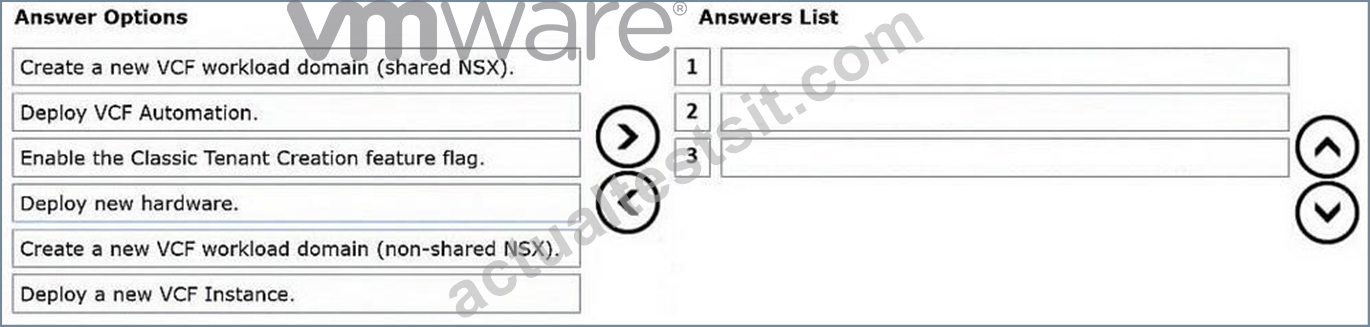
Answer:
Explanation: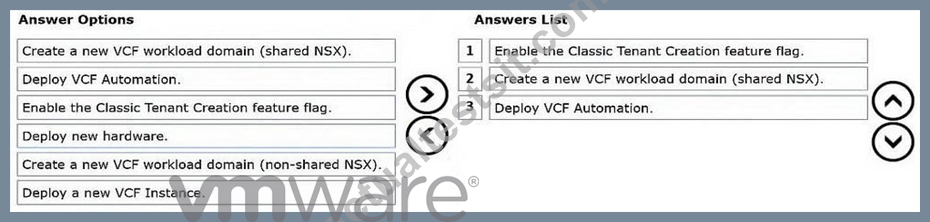
NEW QUESTION # 42
A vSphere administrator has created a new vSphere storage policy, labeled Gold Tier, mapped to some new NVMe-backed datastores.
The VMware Cloud Foundation (VCF) Automation administrator is tasked to permit access to this new storage type for consumers of a PerformanceTest Project in an AllApps organization named Engineering.
What must be done within VCFA to accomplish the task?
- A. Configure a Day-2 policy on the PerformanceTest project to enforce Gold Tier as the preferred storage.
- B. Create a new VMApps Organization for Engineering and ensure the Gold Tier vSphere storage policy is selected for new projects.
- C. Add the Storage Class backed by the Gold Tier storage policy to a Supervisor Namespace Class and bind that Namespace Class to the PerformanceTest Project.
- D. Create a new Zone in VCF Automation, select the Gold Tier vSphere storage policy, and assign the Zone to the PerformanceTest Project.
Answer: C
Explanation:
In an AllApps organization, storage policies are exposed to workloads through Kubernetes storage classes defined in Supervisor Namespace Classes. To make the new Gold Tier storage available, the corresponding storage class must be included in a Namespace Class and then bound to the project so workloads can consume it.
NEW QUESTION # 43
In VMware Cloud Foundation (VCF) Automation, which two statements identify the relationship between a storage policy and a region? (Choose two.)
- A. A storage policy can be associated with one or more regions.
- B. Storage policies must be replicated across all regions using the VCF Automation REST API.
- C. Storage policies determine which datastores are available in a region.
- D. Regions can only use the default vSphere storage policy.
- E. Regions automatically create storage policies based on cluster configuration.
Answer: A,C
Explanation:
In VCF 9.0, the Region construct acts as the bridge between physical vSphere infrastructure and the logical automation consumption layer. Storage policies (SPBM) are used to abstract the underlying physical datastores (such as vSAN, VMFS, or vVOLs). A region identifies which storage policies are available for consumption by the tenant organizations mapped to it. Consequently, storage policies determine which datastores are available within a region; if a datastore is not associated with a policy selected during region configuration, it cannot be used for workload placement. Furthermore, a storage policy can be associated with one or more regions. This allows a provider to offer standardized "Gold," "Silver," or "Bronze" storage tiers across different geographic or logical regions of the VCF fleet, ensuring a consistent consumption experience for developers regardless of which physical workload domain their virtual machines or Kubernetes pods are deployed into.
NEW QUESTION # 44
Drag and Drop Question
An organization administrator has been tasked with adding a certificate to their organization in VCF Automation.
What three actions are required?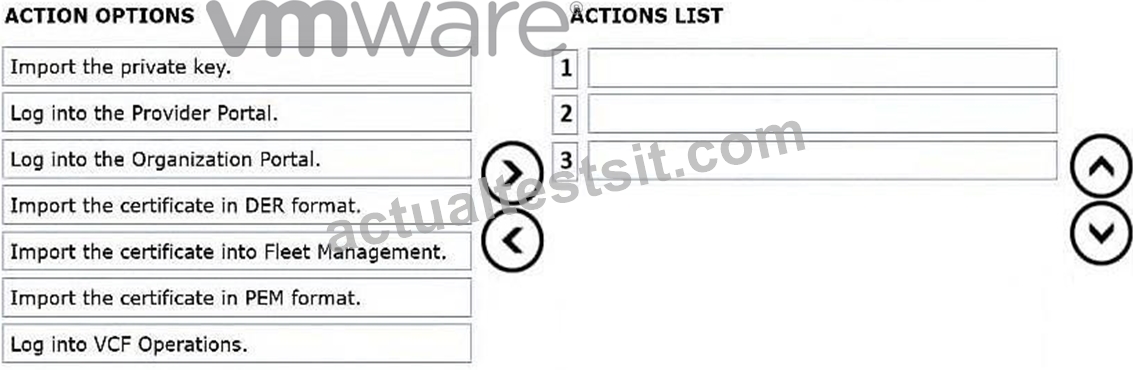
Answer:
Explanation: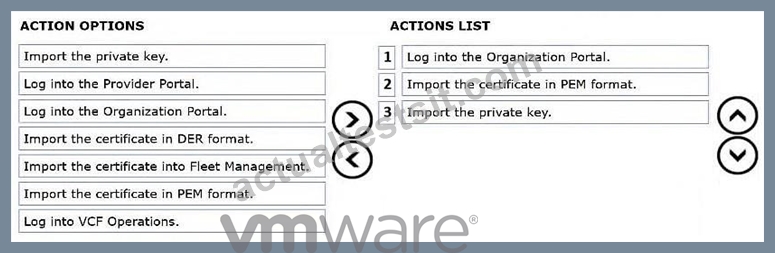
NEW QUESTION # 45
The product development team is rolling out several new application stacks and require a self- service option to deploy their applications quickly and consistently.
The requirements are:
- Present only approved application configurations.
- No manual configuration within a blueprint.
Which VMware Cloud Foundation (VCF) Automation approach meets these requirements?
- A. Integrate VCFA with a Git repository containing blueprint YAML files and train the team to update infrastructure parameters properly before committing changes.
- B. Publish all available blueprints to a catalog so team members can choose what is required and adjust configurations as needed at request time.
- C. Publish pre-approved blueprints with all required inputs preconfigured to a catalog so team members can deploy them directly.
- D. Publish pre-approved blueprints to a catalog and allow the team to choose infrastructure options such as compute cluster and storage policy during deployment.
Answer: C
Explanation:
Publishing only pre-approved blueprints with all required inputs preconfigured ensures users can deploy standardized application stacks through self-service without modifying any blueprint configuration, meeting both consistency and control requirements.
NEW QUESTION # 46
A VMware Cloud Foundation (VCF) Automation administrator is creating a new organization for the Product Development team. The developers require self-service networking that allows them to:
- Provision workloads with virtual machines (VMs) and Kubernetes
services.
- Attach these workloads to VPCs.
- Customize how ingress and egress traffic is handled.
Which configuration meets the requirement?
- A. Create an AllApps Organization and assign multiple vSphere-backed networks for consumers to select as needed.
- B. Create a VMApps Organization and assign multiple vSphere-backed networks for consumers to select as needed.
- C. Create a VMApps Organization and use the default VPC with VPC connectivity profiles.
- D. Create an AllApps Organization and use the default VPC with VPC connectivity profiles.
Answer: D
Explanation:
An AllApps Organization supports both VM and Kubernetes workloads and provides VPC-based networking. Using VPC connectivity profiles allows developers to attach workloads to VPCs and customize ingress and egress behavior, enabling the required self-service networking capabilities.
NEW QUESTION # 47
The administrator is tasked with configuring hard tenancy in VMware Cloud Foundation (VCF) Automation. Which statement reflects how multi-tenancy is configured?
- A. AllApps organizations enable hard tenancy within VCF Automation.
- B. Namespaces enable hard tenancy within VCF Automation.
- C. VMApps organizations enable hard tenancy within VCF Automation.
- D. VCF Automation 9 does not support multi-tenancy. That's on the roadmap for VCFA 10.
- E. Namespace Classes enable hard tenancy construct within VCF Automation.
Answer: C
Explanation:
VMApps organizations provide hard tenancy by dedicating underlying infrastructure resources to a single organization, ensuring isolation without sharing compute, storage, or network resources with other organizations.
NEW QUESTION # 48
A VMware Cloud Foundation (VCF) Automation administrator has been tasked with ensuring that all newly- deployed virtual machines (VMs) provisioned in the Finance Organization are automatically configured for disaster recovery protection using VMware Live Recovery (VLR). Finance is an AIIApps Organization in VCFA.
Which statement meets this requirement?
- A. Create a Day 2 policy that adds the VMs to a VLR Protection Group. Attach the policy to all catalog items available in the Finance Organization.
- B. Create a catalog item that calls an ABX workflow to add the VMs to VLR.
- C. Create a Day 2 action, scoped to the Finance Organization, that assigns the appropriate VLR Protection Group to all deployments.
- D. Configure an Event Subscription that triggers an Orchestrator workflow to protect the VMs in VLR.
Answer: A
Explanation:
In VCF 9.0, Policies are the most scalable way to enforce compliance and operational standards across an organization without modifying individual blueprints. To ensure all VMs are automatically protected by VMware Live Recovery (VLR), the administrator should Create a Day 2 policy. This policy type can be configured to automatically apply a "VLR Protection Group" assignment as a post-provisioning step. By attaching the policy to all catalog items within the Finance Organization, the administrator guarantees that regardless of which blueprint a user chooses, the protection logic is consistently applied. This "Policy-as- Code" approach is superior to manual event subscriptions (Option A) or individual catalog items (Option B) because it centralizes governance; if the protection requirements change, the admin only needs to update the single policy rather than dozens of separate scripts or subscriptions. This ensures that the Finance team's workloads remain compliant with disaster recovery mandates from the moment they are deployed.
NEW QUESTION # 49
An administrator is tasked with configuring an existing Organization to enable users to create namespaces with GPU resources on their assigned Projects.
The Organization is backed by a Region with a GPU-enabled supervisor on a single zone setup.
What needs to be configured for this requirement?
- A. NVIDIA grid_a100-40c profile.
- B. GPU enabled VM Classes.
- C. Namespace Class with VM Class Reservations.
- D. NVIDIA GPU Operator.
Answer: C
Explanation:
To enable users to create namespaces with GPU resources in VCF Automation, the administrator must configure a Namespace Class that includes the appropriate VM Class reservations. This is what governs resource allocation, including GPU-backed compute, for namespaces within projects.
NEW QUESTION # 50
An organization administrator has been tasked with adding a certificate to their organization in VCF Automation. What three actions are required? (Choose three.)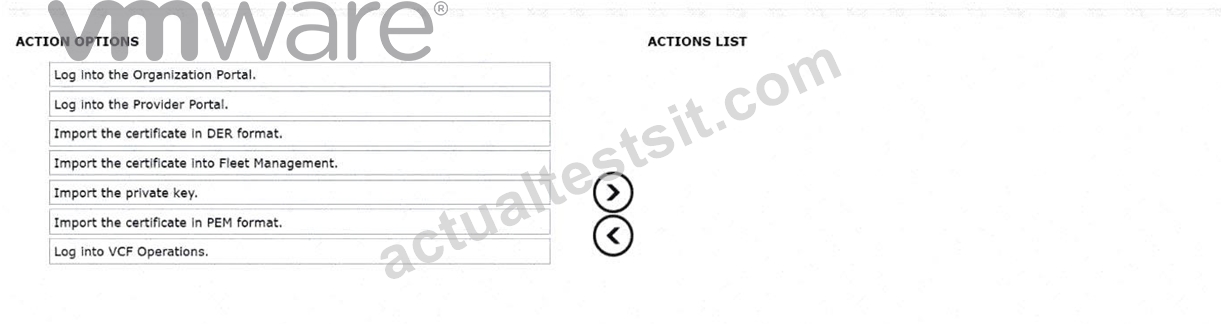
Answer:
Explanation: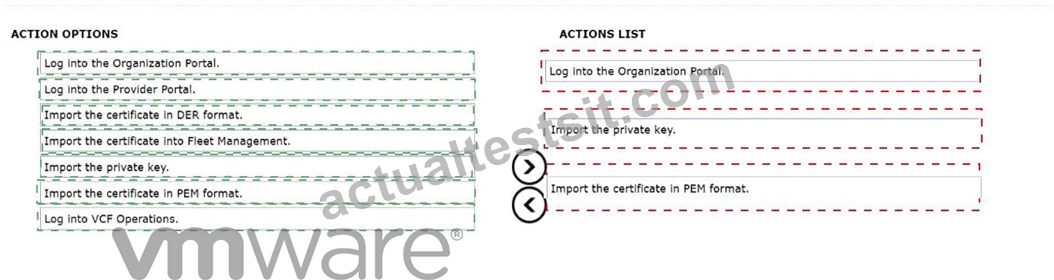
Explanation:
To add a certificate to an organization in VMware Cloud Foundation (VCF) Automation, the organization administrator must perform the following three required actions:
Answer
* Log into the Organization Portal.
* Import the private key.
* Import the certificate in PEM format.
In VCF Automation 9.0, managing identity and security at the tenant level is performed within the Organization Portal. This portal allows organization administrators to configure tenant-specific settings, including branding and certificates, independently of the provider.
The requirements for adding a certificate involve these key components:
* Administrative Interface: While global infrastructure certificates are managed in the Provider Portal, tenant-specific certificates used for securing an organization's internal services or custom domains are added through the Organization Portal.
* Certificate Format: Standard practice for these integrations is to use the PEM (Privacy Enhanced Mail) format, which is a base64 encoded text format widely supported for secure exchanges. The DER (Distinguished Encoding Rules) format is binary and typically not the primary requirement for these web-based portal imports.
* Security Pair: To establish a valid, secure connection, both the certificate itself and its associated private key must be imported into the organization's identity store. The private key is essential for the decryption process and must be handled securely during the import process.
NEW QUESTION # 51
A VMware Cloud Foundation (VCF) Automation Administrator is tasked to enable VCF Automation with the following requirements:
* All companies are hosted within a single private cloud.
* RBAC (role-based access control) is enforced.
* Resource governance within companies.
* Segregation between companies.
What two actions must the VCF Automation Administrator perform to satisfy the requirements? (Choose two.)
- A. Ensure that the vCenter instance has a Supervisor cluster enabled.
- B. Deploy a vCenter instance with a Supervisor cluster per company.
- C. Create and configure an AllApps Organization per company.
- D. Deploy a VCF Operations Orchestrator server to enable multi-tenancy.
- E. Create and configure a VMApps Organization per company.
Answer: A,E
Explanation:
In VMware Cloud Foundation 9.0, multi-tenancy is structured around the concept of Organizations. To meet the requirement of hosting multiple companies within a single private cloud with strict segregation and governance, the administrator must utilize the VMApps Organization model. Unlike the AllApps model, which is highly optimized for modern containerized and VPC-driven workloads, the VMApps Organization is specifically designed for environments requiring traditional VM-centric segregation and access control while sharing underlying physical infrastructure. Enabling a Supervisor cluster on the vCenter instance is a foundational prerequisite for these advanced automation capabilities. The Supervisor provides the necessary integration between the vSphere compute layer and the VCF Automation control plane, allowing for the instantiation of the Namespace and Organization constructs that enforce RBAC and resource quotas. By configuring a VMApps Organization per company, the administrator ensures that each tenant has a distinct administrative boundary, private catalog, and isolated resource allocation, effectively satisfying the requirements for hard tenancy within a consolidated private cloud environment.
NEW QUESTION # 52
A customer requires a backup of blueprints within VMware Cloud Foundation (VCF) Automation to a third- party solution each time the blueprint is released.
What construct will satisfy the requirement?
- A. CloudConfig
- B. Velero service
- C. ArgoCD service
- D. Event broker subscription
Answer: D
Explanation:
To automate the export or backup of Blueprints (Cloud Templates) in VCF 9.0, the Event Broker Service (EBS) is the required mechanism. While Velero (Option A) is used for backing up vSphere Pods and ArgoCD (Option C) is for continuous delivery, neither is designed to "listen" for internal automation metadata changes.
By creating an Event Broker Subscription mapped to the "Blueprint Released" or "Template Version Created" topic, the administrator can trigger an action every time a developer finalizes a new version of their infrastructure code. This triggered action (typically an ABX or Orchestrator task) can then programmatically retrieve the YAML definition of the blueprint via the VCF Automation API and push it to an external third- party storage solution or a secondary Git repository for long-term archival and backup. This ensures that the organization maintains a complete, off-appliance history of its infrastructure designs, satisfying auditing and disaster recovery requirements.
NEW QUESTION # 53
A development team submits the following requirements to the VMware Cloud Foundation (VCF) Automation administrator:
* Three-tier inventory system (web, application, and database).
* All components deployed as virtual machines (VMs).
* Static IP addresses required.
* NAT and load balancing for external access.
* Network segmentation between DMZ and internal tiers.
* The team requests to use the platform's managed PostgreSQL database service instead of maintaining their own database virtual machines.
Which organization type should the administrator configure to meet these requirements with minimal complexity?
- A. VMApps Organization
- B. AllApps Organization
- C. Provider Organization
- D. Kubernetes Apps Organization
Answer: B
Explanation:
To satisfy the requirement for a mix of traditional Virtual Machines and modern managed services like a managed PostgreSQL database, the AllApps Organization is the ideal choice in VCF 9.0. While a VMApps Organization excels at basic VM lifecycle management, it lacks the native integration for "higher- level" managed services provided by the vSphere Supervisor. The AllApps model is designed specifically to bridge the gap between IaaS and PaaS. It allows the administrator to provision NSX VPCs, which natively handle complex networking requirements such as NAT, load balancing, and multi-tier segmentation (DMZ vs.
Internal) with significantly less manual configuration than traditional NSX segments. Furthermore, the AllApps organization provides direct access to Supervisor Services, which include managed data services like PostgreSQL. This allows the development team to consume a database as a service (DBaaS) while still deploying their web and application logic as standard VMs within the same governed environment and VPC, fulfilling all technical requirements within a single, unified consumption interface.
NEW QUESTION # 54
An organization uses a centralized external Configuration Management Database (CMDB) to track all infrastructure assets. Currently, when a new virtual machine (VM) is provisioned through VMware Cloud Foundation (VCF) Automation, operations teams are required to manually input associated metadata into the CMDB.
An administrator is tasked with reducing the manual effort and increasing efficiency of this process using VCF Automation.
Which three of the following can VCF Automation perform? (Choose three.)
- A. Create a webhook endpoint on VCF with payload containing the required metadata.
- B. Request additional metadata as input during the deployment of the blueprint.
- C. Configure a subscription that reacts to VM provisioning requests.
- D. Create a new event topic that creates a notification upon successful VM provisioning.
- E. Call a webhook endpoint on the CMDB API with payload containing the required metadata.
Answer: B,C,E
Explanation:
To automate CMDB updates in VCF 9.0, administrators leverage the Event Broker Service (EBS) and Custom Forms. First, the administrator can Request additional metadata as input during the blueprint request. This ensures that unique information, such as "Cost Center" or "Application ID," is captured directly from the user at request time. Second, the admin must Configure a subscription that specifically listens for the "Post-Provisioning" event topic. This subscription acts as the trigger for the automation logic. Finally, the subscription invokes an ABX action or Orchestrator workflow that is programmed to Call a webhook endpoint on the CMDB API. This call sends a JSON payload containing both the system-generated metadata (e.g., VM UUID, IP address) and the user-provided inputs directly to the CMDB. This "closed-loop" automation eliminates manual data entry, reduces human error, and ensures that the asset repository is updated in real-time as soon as the infrastructure is live.
NEW QUESTION # 55
In VMware Cloud Foundation (VCF) Automation, which construct within an AllApps organization consists of one or more Supervisors and supplies compute, memory, storage, and network resources to the organization?
- A. Cloud Account
- B. Cloud Zone
- C. Project
- D. Region
Answer: B
Explanation:
A Cloud Zone in an AllApps organization aggregates one or more Supervisors and provides the compute, memory, storage, and network resources that are consumed by projects and deployments.
NEW QUESTION # 56
A company wants to deploy multiple isolated application environments under a single VMware Cloud Foundation Automation instance. Each environment must have its own policies, users, and quotas, while sharing a common Cloud Zone. What should be created for each environment?
- A. Project
- B. Supervisor Namespace
- C. Cloud Account
- D. Region
Answer: A
Explanation:
Project provides isolated environments within a shared Cloud Zone. It defines RBAC, quotas, and policies per environment. Cloud Accounts and Supervisor Namespaces do not provide full governance isolation. Regions are logical groupings only. The key trap is confusing Kubernetes namespace isolation with full VCF Automation project-level governance.
NEW QUESTION # 57
What should an Organization Administrator configure to ensure that three environments (staging, development, and production) are isolated from each other?
- A. Create a single VPC for both staging and development with connectivity profile supporting multiple private CIDRs.
- B. Create a Namespace class for each environment, ensuring limits are configured.
- C. Create a VPC for each environment and ensure no connectivity profiles are selected.
- D. Create a VPC for each environment with a connectivity profile that has only a 'Private - TGW' IPv4 block.
Answer: C
Explanation:
Creating a separate VPC for each environment ensures full network isolation between staging, development, and production. By not attaching any connectivity profile, the VPCs remain completely isolated with no external or shared connectivity, enforcing strict separation.
NEW QUESTION # 58
......
VMware 3V0-21.25 Exam Syllabus Topics:
| Topic | Details |
|---|---|
| Topic 1 |
|
| Topic 2 |
|
| Topic 3 |
|
| Topic 4 |
|
| Topic 5 |
|
Verified 3V0-21.25 exam dumps Q&As with Correct 80 Questions and Answers: https://protechtraining.actualtestsit.com/VMware/3V0-21.25-exam-prep-dumps.html