

Free 365 Days Exam Updates FCSS_NST_SE-7.4 dumps with test Engine Practice
Updated Verified FCSS_NST_SE-7.4 dumps Q&As - 100% Pass Guaranteed
NEW QUESTION # 15
Refer to the exhibit, which shows the output of get router info bgp summary.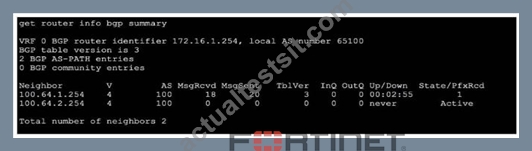
Which two statements are true? (Choose two.)
- A. The local ForliGate has received one prefix from BGP neighbor 100.64.1.254.
- B. The TCP connection with BGP neighbor 100.64.2.254 was successful.
- C. The local FortiGate has received 18 packets from a BGP neighbor.
- D. The local FortiGate is still calculating the prefixes received from BGP neighbor 100.64.2.264
Answer: A,C
NEW QUESTION # 16
What are two functions of automation stitches? (Choose two.)
- A. You can set an automation stitch configured to execute actions in parallel to insert a specific delay between actions.
- B. You can configure automation stitches to execute actions sequentially by taking parameters from previous actions as input for the current action.
- C. You can create automation stitches to run diagnostic commands and attach the results to an email message when CPU or memory usage exceeds specified thresholds.
- D. You can configure automation stitches on any FortiGate device in a Security Fabric environment.
Answer: B,C
NEW QUESTION # 17
Refer to the exhibits.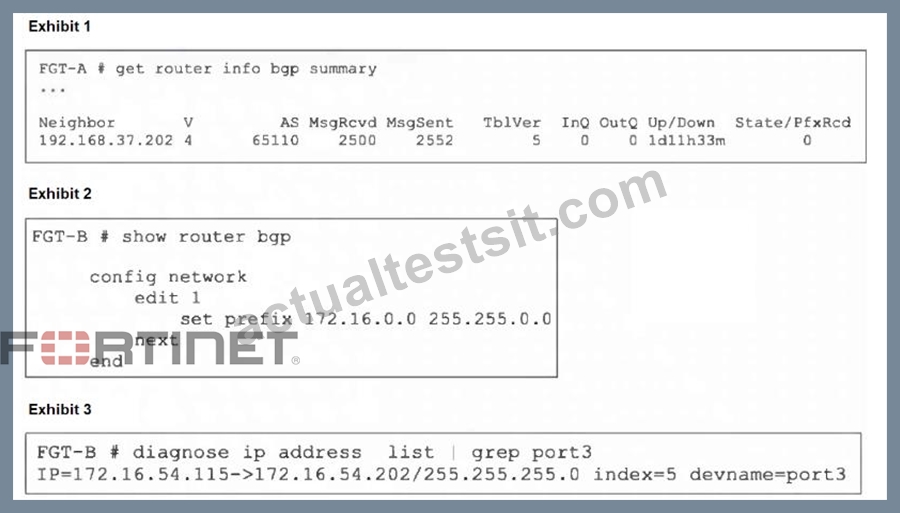
An administrator is attempting to advertise the network configured on port3. However, FGT-A is not receiving the prefix.
Which two actions can the administrator take to fix this problem? (Choose two.)
- A. Modify the prefix using the network command from 172.16.0.0/16 to 172.16.54.0/24.
- B. Manually add the BGP route on FGT-A.
- C. Use the set network-import-check disable command.
- D. Restart BGP using a soft reset to force both peers to exchange their complete BGP routing tables.
Answer: A,C
NEW QUESTION # 18
Refer to the exhibit, which shows the output ofa debug command.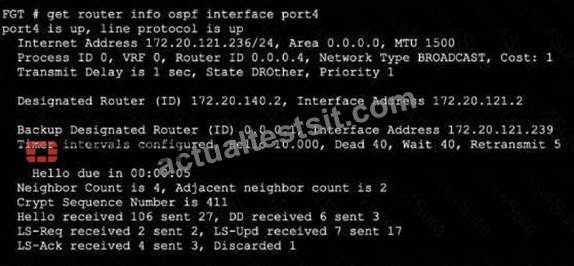
Which two statements about the output are true? (Choose two.)
- A. In the network connected to port4, two OSPF routers are down.
- B. One of the neighbors has a router ID of 0.0.0.4.
- C. There are a total of five OSPF routers attached to the vorz4 network segment
- D. The interlace is part of the OSPF backbone area.
Answer: A,D
NEW QUESTION # 19
Which two statements are true regarding heartbeat messages sent from an FSSO collector agent to FortiGate? (Choose two.)
- A. The heartbeat messages must be manually enabled on FortiGate.
- B. The heartbeat messages can be seen on FortiGate using the real-lime FSSO debug.
- C. The heartbeat messages can be seen using the command diagnose debug authd fsso list.
- D. The heartbeat messages can be seen in the collector agent logs.
Answer: B,D
NEW QUESTION # 20
The local OSPF router is unable to establish adjacency with a peer.
Which two things should the administrator do to troubleshoot the issue? (Choose two.)
- A. Check whether TCP port 179 is blocked.
- B. Check whether both peers have an IP address within the same subnet.
- C. Check if there is an active static route to the peer.
- D. Check if IP protocol 89 is blocked.
Answer: B,D
NEW QUESTION # 21
Refer to the exhibit.
The exhibit shows the output from using the command diagnose debug application samld -1 to diagnose a SAML connection.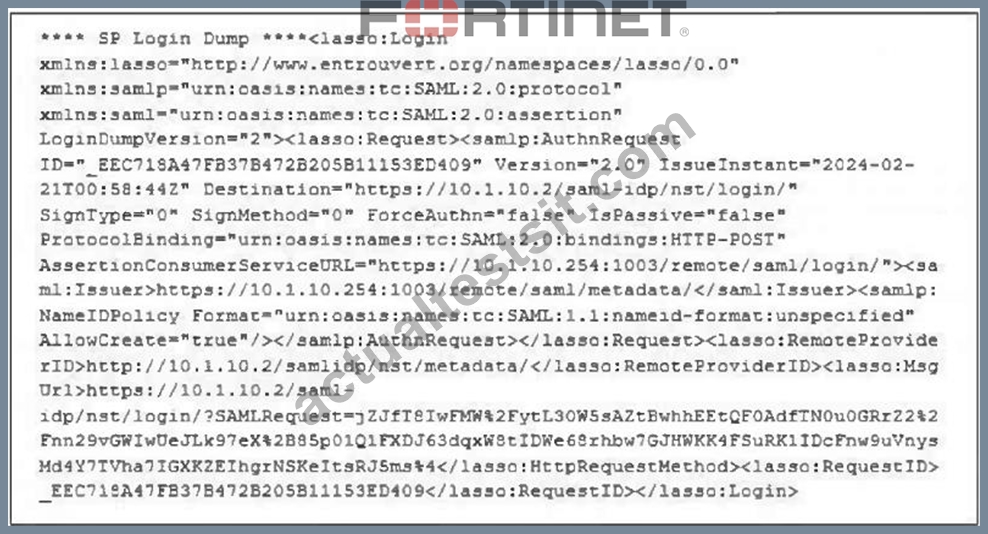
Based on this output, what can you conclude?
- A. The authentication request is for an SSL VPN connection.
- B. The IdP IP address is 10.1.10.2.
- C. The IdP IP address is 10.1.10.254.
- D. Active Directory is used for authentication.
Answer: B
NEW QUESTION # 22
Exhibit.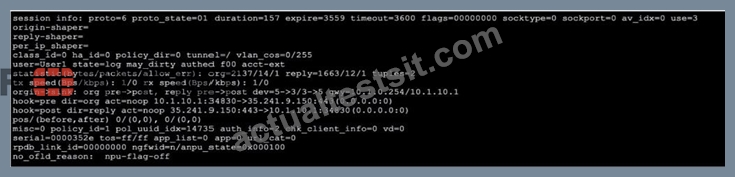
Refer to the exhibit, which shows the output of a session. Which two statements are true? (Choose Iwo.)
- A. The session is being inspected using flow inspection.
- B. The TCP session has been successfully established.
- C. The session was initiated from an authenticated user.
- D. The session is being offloaded.
Answer: B,C
NEW QUESTION # 23
Refer to the exhibit, which contains the output of diagnose vpn tunnel list.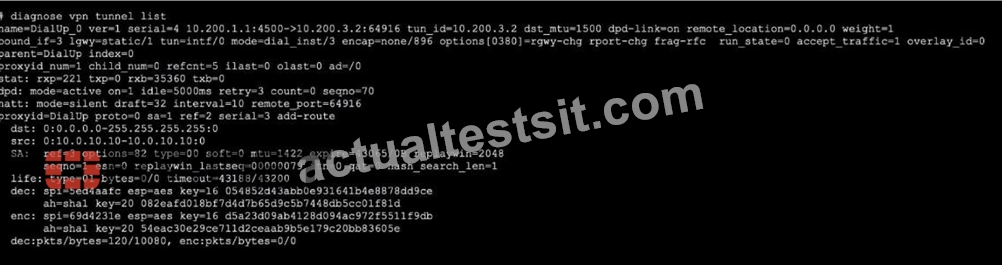
Which command will capture ESP traffic for the VPN named DialUp_0?
- A. diagnose sniffer packet any 'esp and host 10.200.3.2'
- B. diagnose sniffer packet any 'port 4500'
- C. diagnose sniffer packet any 'host 10.0.10.10'
- D. diagnose sniffer packet any 'ip proto 50'
Answer: B
NEW QUESTION # 24
Exhibit.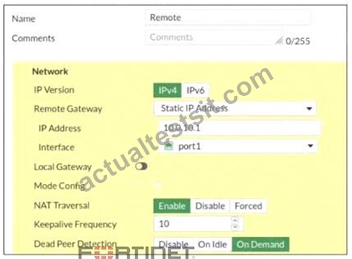
Refer to the exhibit, which contains a screenshot of some phase 1 settings.
The VPN is not up. To diagnose the issue, the administrator enters the following CLI commands on an SSH session on FortiGate:
However, the IKE real-time debug does not show any output. Why?
- A. Replace diagnose debug application ike -1 with diagnose debug application ipsec -1.
- B. The log-filter setting is incorrect. The VPN traffic does not match this filter.
- C. The administrator must also run the command diagnose debug enable.
- D. The debug shows only error messages. If there is no output, then the phase 1 and phase 2 configurations match.
Answer: C
NEW QUESTION # 25
During which phase of IKEv2 does the Diffie-Helman key exchange take place?
- A. IKE_Req_INIT
- B. IKE_SA_INIT
- C. IKE_Auth
- D. Create_CHILD_SA
Answer: B
NEW QUESTION # 26
Refer to the exhibit, which shows the output of diagnose sys session list.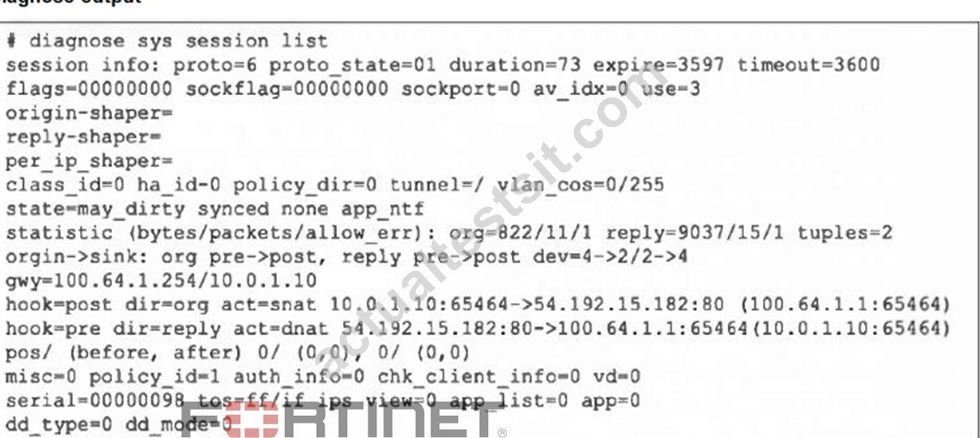
If the HA ID for the primary device is 0, what happens if the primary fails and the secondary becomes the primary?
- A. The session will be removed from the session table of the secondary device because of the presence of allowed error packets, which will force the client to restart the session with the server.
- B. The session state is preserved but the kernel will need to re-evaluate the session because NAT was applied.
- C. Traffic for this session continues to be permitted on the new primary device after failover, without requiring the client to restart the session with the server.
- D. The secondary device has this session synchronized; however, because application control is applied, the session is marked dirty and has to be re-evaluated after failover.
Answer: C
NEW QUESTION # 27
Exhibit.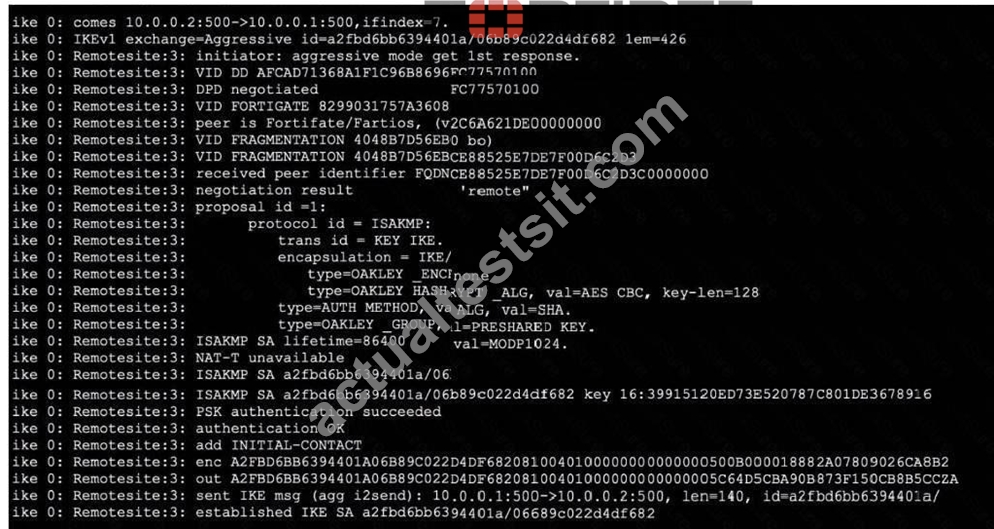
Refer to the exhibit, which contains partial output from an IKE real-time debug.
Which two statements about this debug output are correct? (Choose two.)
- A. The initiator provided remote as its IPsec peer ID.
- B. The local gateway IP address is 10.0.0.1.
- C. Perfect Forward Secrecy (PFS) is enabled in the configuration.
- D. It shows a phase 2 negotiation.
Answer: A,D
NEW QUESTION # 28
Refer to the exhibit, which shows the output of a policy route table entry.
Which type of policy route does the output show?
- A. An ISDB route
- B. A regular policy route
- C. An SD-WAN rule
- D. A regular policy route, which is associated with an active static route in the FIB
Answer: A
NEW QUESTION # 29
Refer to the exhibit, which shows the output of get router info ospf neighbor.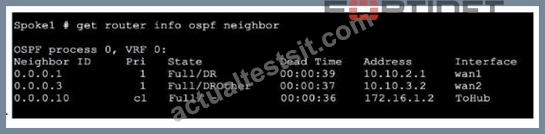
What can you conclude from the command output?
- A. The local FortiGate is the BDR.
- B. The network type connecting the local Fortigate and OSPF neighbor 0.0.0.10 is point-to-point.
- C. The local FortiGate is not a DROther.
- D. All neighbors are in area 0.0.0.0.
Answer: B
NEW QUESTION # 30
......
Provide Valid Dumps To Help You Prepare For FCSS - Network Security 7.4 Support Engineer Exam: https://protechtraining.actualtestsit.com/Fortinet/FCSS_NST_SE-7.4-exam-prep-dumps.html