

[Jan 14, 2026] Verified FCP_FAZ_AN-7.6 dumps and 68 unique questions
FCP_FAZ_AN-7.6 Dumps for Pass Guaranteed - Pass FCP_FAZ_AN-7.6 Exam 2026
NEW QUESTION # 24
You are tasked with finding logs corresponding to a suspected attack on your network. You need to use an interface where all identified threats within timeframe are listed and organized. You also need to be able to quickly export the information to a PDF file.
Where can you go to accomplish this task?
- A. Log Browse
- B. Fabric View
- C. Log View
- D. FortiView
Answer: D
Explanation:
FortiView is a comprehensive monitoring system on FortiAnalyzer that integrates real-time and historical data into a single view, including threats. It provides intuitive summary dashboards listing top threats, sources, destinations, and more, all filterable by timeframe and other criteria.
FortiView allows drill-down into detailed threat information and supports exporting data and reports, including to PDF format, facilitating quick sharing and analysis.
https://docs.fortinet.com/document/fortigate/7.6.3/administration-guide/96300/using-the-fortiview- interface
NEW QUESTION # 25
You find that as part of your role as an analyst, you frequently search log View using the same parameters.
Instead of defining your search filters repeatedly, what can you do to save time?
- A. Configure a custom dashboard.
- B. Configure a custom view.
- C. Configure a data selector.
- D. Configure a marco and apply it to device groups.
Answer: B
Explanation:
When you frequently use the same search parameters in FortiAnalyzer's Log View, setting up a reusable filter or view can save considerable time.
Option B - Configure a Custom View:
Custom views in FortiAnalyzer allow analysts to save specific search filters and configurations. By setting up a custom view, you can retain your frequently used search parameters and quickly access them without needing to reapply filters each time. This option is specifically designed to streamline the process of recurring log searches.
NEW QUESTION # 26
Which statement about automation connectors in FortiAnalyzer is true?
- A. An ADOM with the Fabric type comes with multiple connectors configured.
- B. The local connector becomes available after you connectors are displayed.
- C. The actions available with FortiOS connectors are determined by automation rules configured on FortiGate.
- D. The local connector becomes available after you configured any external connector.
Answer: C
NEW QUESTION # 27
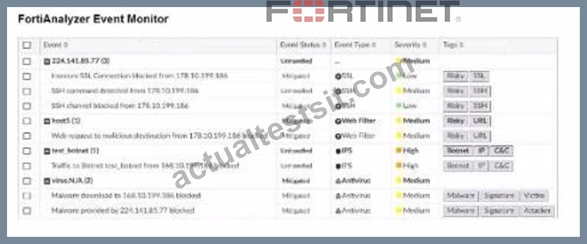
Exhibit. Assume these are all the events that exist on the FortiAnalyzer device. How many events will be added to the incident created after running this playbook?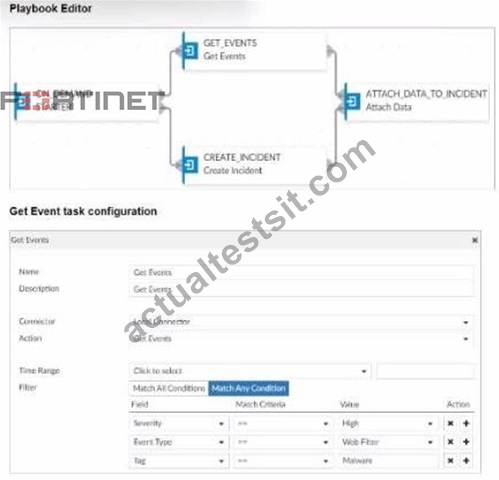
- A. Four events will be added.
- B. Eleven events will be added.
- C. No events will be added.
- D. Seven events will be added
Answer: A
Explanation:
In the exhibit, we see a playbook in FortiAnalyzer designed to retrieve events based on specific criteria, create an incident, and attach relevant data to that incident. The "Get Event" task configuration specifies filters to match any of the following conditions:
Severity = High
Event Type = Web Filter
Tag = Malware
Analysis of Events:
In the FortiAnalyzer Event Monitor list:
We need to identify events that meet any one of the specified conditions (since the filter is set to
"Match Any Condition").
Events Matching Criteria:
Severity = High:
There are two events with "High" severity, both with the "Event Type" IPS.
Event Type = Web Filter:
There are two events with the "Event Type" Web Filter. One has a "Medium" severity, and the other has a "Low" severity.
Tag = Malware:
There are two events tagged with "Malware," both with the "Event Type" Antivirus and "Medium" severity.
After filtering based on these criteria, there are four distinct events:
Two from the "Severity = High" filter.
One from the "Event Type = Web Filter" filter.
One from the "Tag = Malware" filter.
NEW QUESTION # 28
Which two FortiAnalyzer features allow you to automatically build a dataset and chart based on a filtered search result? (Choose two.)
- A. Dataset Library
- B. Export to Report Chart (FortiView)
- C. Custom View
- D. Chart Builder
Answer: B,D
NEW QUESTION # 29
Which statement correctly describes one Difference between templates and reports?
- A. Template are mapped to device groups. while reports are mapped to ADOMs
- B. Reports provide mora configuration options than templates
- C. Reports support macros, but templates do not.
- D. Templates can be cloned, but reports cannot be cloned.
Answer: B
NEW QUESTION # 30
Which statement regarding macros on FortiAnalyzer is true?
- A. Macros are useful in generating excel log files automatically based on the report settings.
- B. Macros are supported only on the FortiGate ADOMs.
- C. Macros are predefined templates for reports and cannot be customized.
- D. Macros are ADOM-specific and each ADOM type have unique macros relevant to that ADOM.
Answer: D
Explanation:
Macros on FortiAnalyzer are predefined or custom query templates used in reports, and they are organized by ADOM (Administrative Domain). When using ADOMs, you must be in the correct ADOM to create or manage macros, indicating that macros are ADOM-specific and tailored to the device types or datasets relevant to that ADOM.
https://docs.fortinet.com/document/fortianalyzer/7.6.3/administration-guide/617380/creating- macros
NEW QUESTION # 31
Which two methods can you use to send notifications when an event occurs that matches a configured event handler? (Choose two.)
- A. Send SMS notification
- B. Send SNMP trap
- C. Send Alert through FortiSIEM MEA
- D. Send Alert through Fabric Connectors
Answer: B,D
Explanation:
Send Alert through Fabric Connectors: This method involves creating a Fabric Connector profile and selecting the option "Send Alert through Fabric Connectors" in the event handler notification settings. Notifications are then sent in JSON format to the configured endpoint, such as Microsoft Teams or other integrated platforms.
Send SNMP trap: You can configure SNMP traps to be sent when an event triggers an incident.
This involves setting the SNMP Trap IP address, community string, trap type, and protocol in the system's analytics or incident settings.
NEW QUESTION # 32
You crested a playbook on FortiAnalyzer that uses a FortiOS connector.
When configuring the FortiGate side, which type of trigger must be used so that the actions in an automation stitch are available in the FortiOS connector?
- A. FortiOS Event Log
- B. Fabric Connector event
- C. FortiAnalyzer Event Handler
- D. Incoming webhook
Answer: D
Explanation:
When using FortiAnalyzer to create playbooks that interact with FortiOS devices, an Incoming Webhook trigger is required on the FortiGate side to make the actions in an automation stitch accessible through the FortiOS connector. The incoming webhook trigger allows FortiAnalyzer to initiate actions on FortiGate by sending HTTP POST requests to specified endpoints, which in turn trigger automation stitches defined on the FortiGate.
NEW QUESTION # 33
What is the purpose of playbook trigger variables?
- A. To use information from the trigger to filter the action in a task
- B. To provide the trigger information to make the playbook start running
- C. To store the start the times of playbooks with On_Schedule triggers
- D. To display statistics about the playbook runtime
Answer: D
NEW QUESTION # 34
Refer to the exhibit. What can you conclude about the output?
- A. The low indexing values require investigation.
- B. The output is not ADOM specific.
- C. There are more event logs than traffic logs.
- D. The log rate higher than the message rate is not normal.
Answer: D
NEW QUESTION # 35
Refer to the exhibit. What is the purpose of using the Chart Builder feature on FortiAnalyzer?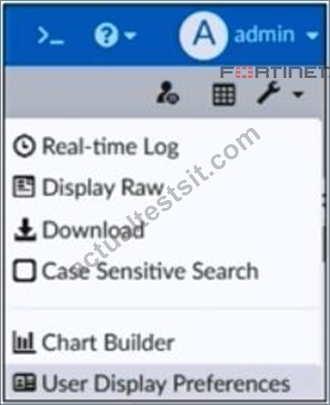
- A. To build a dataset and chart based on the filtered search results
- B. To add a new chart under FortiView to be used in new reports
- C. To build a chart automatically based on the top 100 log entries
- D. To add charts directly to generate reports in the current ADOM.
Answer: A
Explanation:
A quick way to build a custom dataset and chart is to use the chart builder tool. This tool is located in LogView, and allows you to build a dataset and chart automatically, based on your filtered search results. In LogView, set filters to return the logs you want.
NEW QUESTION # 36
What is the purpose of using data selectors when configuring event handlers?
- A. They download new filters can be used in event handlers.
- B. They filter the types of logs that FortiAnalyzer can accept from registered devices.
- C. They are common filters that can be applied simultaneously to all event handlers.
- D. They apply their filter criteria to the entire event handler so that you don't have to configure the same criteria in the individual rules.
Answer: D
NEW QUESTION # 37
Which statement about the FortiSOAR management extension is correct?
- A. It runs as a docker container on FortiAnalyzer.
- B. It does not include a limited trial by default.
- C. It requires a dedicated FortiSOAR device or VM.
- D. It requires a FortiManager configured to manage FortiGate.
Answer: C
Explanation:
The FortiSOAR management extension is designed as an independent security orchestration, automation, and response (SOAR) solution that integrates with other Fortinet products but requires its own dedicated device or virtual machine (VM) environment. FortiSOAR is not natively integrated as a container or service within FortiAnalyzer or FortiManager, and it operates separately to manage complex security workflows and incident responses across various platforms.
NEW QUESTION # 38
It is a best practice to upload FortiAnalyzer local logs to a remote server. Which three remote servers are supported for the upload? (Choose three.)
- A. SCP
- B. SFTP
- C. UDP
- D. TCP
- E. FTP
Answer: A,B,E
NEW QUESTION # 39
An administrator on your team has configured multiple reports to run periodically. Management has an additional request that all new generated reports be sent to a company email inbox for accessibility. The mail server has already been configured on FortiAnalyzer. Which item must configure on FortiAnalyzer so that emails are sent when the reports are generated?
- A. Enable email notification under the report calendar.
- B. Add a mailto:<email address> option within the report layouts.
- C. Enable an output profile on the reports.
- D. Enable the option to email all repots under the mail server.
Answer: C
Explanation:
To ensure that reports generated by FortiAnalyzer are automatically sent to an email inbox, you need to set up an output profile for the reports. Output profiles specify where and how reports should be delivered, including the option to send them via email.
Option D - Enable an Output Profile on the Reports:
An output profile can be configured on FortiAnalyzer to define delivery options, including emailing the report to specified recipients. This setup ensures that every time a report is generated according to the schedule, it is automatically emailed to the configured address.
NEW QUESTION # 40
Exhibit. What can you conclude from this output?
- A. FGT_B is the Security Fabric root.
- B. The allocated disk quote to ADOM1 is 3 GB.
- C. Archive logs are using more space than analytic logs.
- D. There is not disk quota allocated to quarantining files.
Answer: B
Explanation:
The exhibit displays a diagnose log device output on a FortiAnalyzer, showing details about disk space usage and quotas for different FortiGate devices and ADOMs (Administrative Domains).
Here's a breakdown of key details:
Disk Quota for Quarantined Files:
The output includes columns labeled for used space in categories such as "logs," "quarantine,"
"content," and "DB." For each device, the quarantine column consistently shows 0.0KB used, indicating that there is no disk quota allocated or utilized for quarantining files.
NEW QUESTION # 41
What happens when the indicator of compromise (IOC) engine on FortiAnalyzer finds web logs that match blacklisted IP addresses?
- A. The detection engine classifies those logs as Suspicious.
- B. A new infected entry is added for the corresponding endpoint under Compromised Hosts.
- C. FortiAnalyzer flags the associated host for further analysis.
- D. The endpoint is marked as Compromised and, optionally, can be put in quarantine.
Answer: B
NEW QUESTION # 42
As part of your analysis, you discover that an incident is a false positive. You change the incident status to Closed: False Positive.
Which statement about your update is true?
- A. The incident number will be changed
- B. The corresponding event will be marked as mitigated.
- C. The audit history log will be updated.
- D. The incident will be deleted.
Answer: C
Explanation:
When an incident in FortiAnalyzer is identified as a false positive and its status is updated to
"Closed:
False Positive," certain records and logs are updated to reflect this change.
Option A - The Audit History Log Will Be Updated:
FortiAnalyzer maintains an audit history log that records changes to incidents, including updates to their status. When an incident status is marked as "Closed: False Positive," this action is logged in the audit history to ensure traceability of changes. This log provides accountability and a record of how incidents have been handled over time.
NEW QUESTION # 43
......
Latest 100% Passing Guarantee - Brilliant FCP_FAZ_AN-7.6 Exam Questions PDF: https://protechtraining.actualtestsit.com/Fortinet/FCP_FAZ_AN-7.6-exam-prep-dumps.html