

[Jun 21, 2026] Pass Fortinet NSE7_SSE_AD-25 Exam Info and Free Practice Test
NSE7_SSE_AD-25 Exam Dumps PDF Updated Dump from ActualTestsIT Guaranteed Success
NEW QUESTION # 22
Which two settings are automatically pushed from FortiSASE to FortiClient in a new FortiSASE deployment with default settings? (Choose two.)
- A. zero trust network access (ZTNA) tags
- B. tunnel profile
- C. real-time protection
- D. FortiSASE certificate authority (CA) certificate
Answer: B,D
Explanation:
In a default FortiSASE deployment, the tunnel profile (for secure connectivity) and the FortiSASE CA certificate (for SSL inspection and trusted communication) are automatically pushed to FortiClient endpoints.
NEW QUESTION # 23
What are two benefits of deploying secure private access (SPA) with SD-WAN? (Choose two answers)
- A. A direct access proxy tunnel from FortiClient to the on-premises FortiGate
- B. Inline security inspection by FortiSASE
- C. ZTNA posture check performed by the hub FortiGate
- D. Support of both TCP and UDP applications
Answer: B,D
Explanation:
According to the NSE7 SASE Enterprise Guide (Pages 46 & 61), deploying Secure Private Access (SPA) with SD-WAN provides advanced security and networking capabilities by routing traffic through global Points of Presence (PoPs).
* Inline Security Inspection (D): A major advantage of this approach is that traffic is routed through FortiSASE PoPs before it reaches private applications. This enables inline security inspection, providing robust protection against threats by applying the full SASE security stack-including antivirus, intrusion prevention, and deep packet inspection-to private access traffic.
* Support for TCP and UDP (B): Organizations with existing FortiGate SD-WAN deployments benefit from broader and seamless access to privately hosted applications. The SD-WAN SPA use case explicitly supports both TCP- and UDP-based applications, ensuring that legacy or specialized services that rely on UDP function correctly over the secure tunnel.
* SD-WAN Optimization: This method leverages the benefits of SD-WAN to optimize traffic flow between the SASE PoP and the corporate SD-WAN hub or data center FortiGate. It is particularly useful for mission-critical applications that require an extra layer of security combined with path optimization.
* Architecture: In this configuration, the FortiSASE Security PoPs act as spokes in the organization's SD-WAN network, relying on IPsec VPN overlays and BGP for secure dynamic routing.
While ZTNA posture checks are a feature of the broader ecosystem, the NSE7 Guide specifically highlights inline inspection and application support (TCP/UDP) as primary advantages of the SD-WAN integrated SPA approach.
NEW QUESTION # 24
Which FortiSASE component protects users from online threats by hosting their browsing sessions on a remote container within a secure environment?
- A. cloud access security broker (CASB)
- B. secure web gateway (SWG)
- C. data loss prevention (DLP)
- D. remote browser isolation (RBI)
Answer: D
Explanation:
Remote Browser Isolation (RBI) protects users by executing their web browsing sessions in a remote, secure container, preventing malicious content from reaching the local device.
NEW QUESTION # 25
A customer configured the On/off-net detection rule to disable FortiSASE VPN auto-connect when users are inside the corporate network. The rule is set to Connects with a known public IP using the company's public IP address. However, when the users are on the corporate network, the FortiSASE VPN still auto-connects.
The customer has confirmed that traffic is going to the internet with the correct IP address.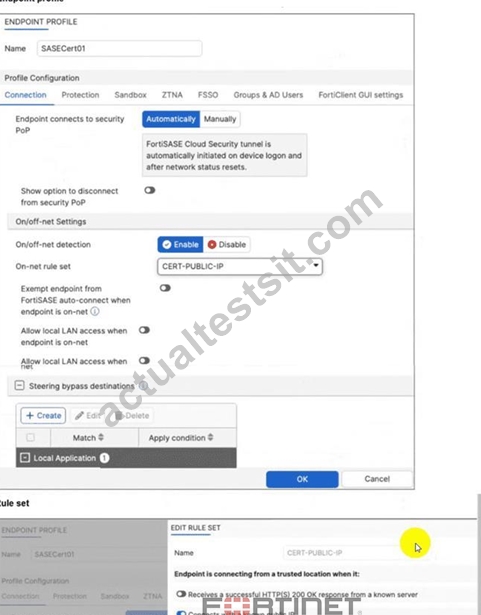
Which configuration is causing the issue? (Choose one answer)
- A. Exempt endpoint from FortiSASE auto-connect is disabled when it should be enabled.
- B. The On-net rule set configuration is incorrect.
- C. Allow local LAN access when endpoint is on-net is disabled when it should be enabled.
- D. Is connected to a known DNS server should be enabled and configured.
Answer: A
Explanation:
The FortiSASE On/off-net detection feature is a two-part configuration designed to optimize bandwidth and user experience by determining when a device is in a trusted environment.
* Rule Set Definition: The first part involves defining what constitutes an "on-net" or "on-fabric" status.
In this scenario, the customer successfully configured a rule set named CERT-PUBLIC-IP using the Connects with a known public IP detection type. This tells FortiSASE that if the endpoint's public WAN IP matches the corporate gateway, it is considered to be on the corporate network.
* Profile Exemption Logic: Defining the rule set is not enough to stop the VPN connection. Within the Endpoint Profile (under the Connection tab > On/off-net Settings), there is a specific toggle labeled Exempt endpoint from FortiSASE auto-connect when endpoint is on-net (or in some versions, Bypass FortiSASE when endpoint is on-net).
* Exhibit Analysis: Looking at the provided exhibit (image_57097d.jpg), the "Exempt endpoint from FortiSASE auto-connect..." toggle is clearly disabled (switched to the left).
* Root Cause: Because this toggle is disabled, FortiClient identifies that it is "on-net" based on the IP rule, but it has no instruction to skip the VPN connection. Consequently, the "Automatically" initiate tunnel setting remains the dominant instruction, causing the VPN to connect regardless of the network location.
To resolve the issue, the administrator must enable the Exempt endpoint from FortiSASE auto-connect when endpoint is on-net option in the SASECert01 profile.
NEW QUESTION # 26
What is the role of ZTNA tags in the FortiSASE Secure Internet Access (SIA) and Secure Private Access (SPA) use cases? (Choose one answer)
- A. ZTNA tags are created to isolate browser sessions in SIA and enforce data loss prevention in SPA for all devices.
- B. ZTNA tags determine device posture for endpoints running FortiClient and are used to grant or deny access in SIA or SPA based on that posture.
- C. ZTNA tags are applied to unmanaged endpoints without FortiClient to secure HTTP and HTTPS traffic in SIA and SPA.
- D. ZTNA tags determine device posture for non-web traffic protocols and are applied only in agentless deployments for SIA.
Answer: B
Explanation:
In the Fortinet SASE architecture, Zero Trust Network Access (ZTNA) tags (which have been renamed to Security Posture Tags starting with FortiClient/EMS 7.4.0) play a critical role in continuous posture assessment. These tags are dynamic metadata assign8ed to an endpoint based on specific conditions or
"tagging rules" defined in the FortiSASE Endpoint Management Service (EMS).
* Posture Determination: The FortiClient agent, installed on the endpoint, monitors the device for various security attributes-such as whether an antivirus is running, the presence of specific registry keys, OS version, or the absence of critical vulnerabilities.
* SIA (Secure Internet Access) Use Case: In SIA scenarios, FortiSASE uses these tags within security policies to control internet access. For example, a policy may allow full internet access only to endpoints tagged as "Compliant" while redirecting "Non-Compliant" devices to a restricted remediation portal.
* SPA (Secure Private Access) Use Case: In SPA (specifically ZTNA Proxy mode), the tags are synchronized from FortiSASE to the corporate FortiGate (acting as the ZTNA Access Proxy).12 When a user attempts to access a private application, the FortiGate checks the endpoint's client certificate and its synchronized ZTNA tags.13 If the endpoint does not meet the required posture (e.g., it is missing a required "Domain-Joined" tag), access is denied at the session level.
According to the FortiSASE 25 Enterprise Administrator Study Guide, ZTNA tags are fundamental to the
"Zero Trust" principle because they move beyond static identity (username/password) to verify the real-time security state of the device before granting access to either the internet or internal private resources.
NEW QUESTION # 27
Refer to the exhibits.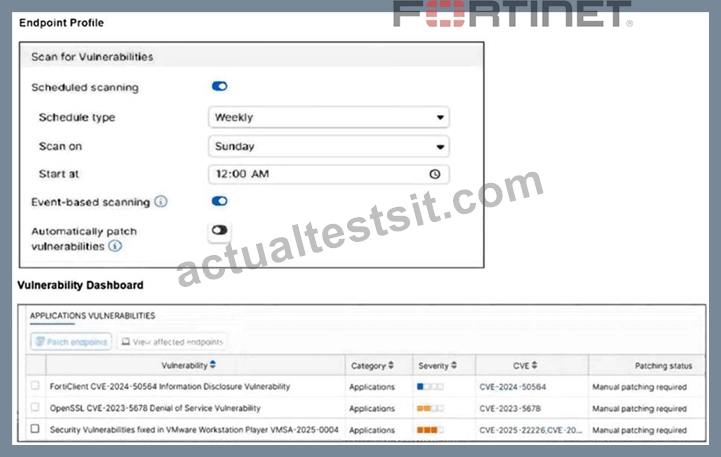
How will the application vulnerabilities be patched, based on the exhibits provided? (Choose one answer)
- A. The vulnerability will be patched by installing the patch from the vendor's website.
- B. The end user will patch the vulnerabilities using the FortiClient software.
- C. An administrator will patch the vulnerability remotely using FortiSASE.
- D. The vulnerability will be patched automatically based on the endpoint profile configuration.
Answer: C
Explanation:
Based on the settings shown in the provided exhibits, the vulnerability remediation workflow is determined by the Endpoint Profile and the Vulnerability Dashboard.
* Endpoint Profile Evaluation: The top exhibit displays the Scan for Vulnerabilities settings. The toggle for Automatically patch vulnerabilities is explicitly set to Disabled. Consequently, the system will not perform automated remediation when a scan completes.
* Manual Patching Requirement: The Vulnerability Dashboard (bottom exhibit) lists several application vulnerabilities with a Patching status of Manual patching required. In a FortiSASE environment, "Manual" indicates that the vulnerability cannot be handled by the client's autonomous update process and requires a direct instruction from the management plane.
* Administrative Intervention: The dashboard includes a Patch endpoints action button. Since auto- patching is disabled in the profile, an administrator must manually select the vulnerabilities and click the "Patch endpoints" button to remotely trigger the patching sequence on the managed endpoints via the FortiSASE cloud service.
* Workflow Logic: While FortiClient acts as the "conductor" on the local machine to facilitate the download and installation, the trigger for this specific scenario is the administrator's remote action within the portal. This differentiates it from Option D (which is disabled) and Option C (which would involve a user manually browsing a website outside the managed SASE workflow).
NEW QUESTION # 28
Which statement applies to a single sign-on (SSO) deployment on FortiSASE?
- A. SSO is recommended only for agent-based deployments.
- B. SSO overrides any other previously configured user authentication.
- C. SSO identity providers can be integrated using public and private access types.
- D. SSO users can be imported into FortiSASE and added to user groups.
Answer: B
Explanation:
In FortiSASE, Single Sign-On (SSO) takes precedence and overrides other configured user authentication methods, ensuring a centralized and streamlined authentication process across services.
NEW QUESTION # 29
What are the key differences between the FortiSASE BGP per overlay and BGP on loopback routing design methods? (Choose one answer)
- A. BGP per overlay simplifies hub configuration without mode-cfg, while BGP on loopback establishes multiple iBGP sessions for each tunnel to increase advertised routes.
- B. BGP per overlay establishes a single iBGP session per hub on a loopback interface, while BGP on loopback requires mode-cfg for IP address assignment and uses multiple iBGP sessions per tunnel.
- C. BGP per overlay is used for loopback interfaces to reduce routes, while BGP on loopback is the default method requiring separate iBGP sessions for each spoke.
- D. BGP per overlay can use separate iBGP sessions for each spoke-to-hub tunnel with mode-cfg enabled for IP address assignment, while BGP on loopback uses a single iBGP session per hub terminating on a loopback interface to simplify configuration and reduce advertised routes.
Answer: D
Explanation:
FortiSASE supports two main routing design methods for Secure Private Access (SPA) when connecting to a FortiGate SD-WAN hub:
* BGP per Overlay (Traditional/Default Method): In this configuration, a separate iBGP session is established over every individual IPsec overlay (tunnel) between the FortiSASE PoP and the hub. These sessions terminate on the tunnel interface IP addresses. To facilitate this, the hubs typically use the IPsec VPN mode-cfg feature to dynamically assign tunnel IP addresses to the SASE PoPs. For every LAN prefix, the system generates multiple BGP routes-one for each overlay-which increases the total number of routes advertised across the network.
* BGP on Loopback (Modern Alternative): This newer design establishes only a single iBGP session between the spoke and the hub, regardless of how many physical or logical overlays (tunnels) connect them. The session is terminated on a loopback interface on both sides.
* Key Advantages of BGP on Loopback:
* Reduced Complexity: It significantly simplifies the BGP configuration because there are fewer neighbors to manage.2
* Improved Scalability: It greatly reduces the volume of routes advertised, as only a single BGP route is generated for each LAN prefix, making it the preferred choice for large-scale deployments.
* Resiliency: The BGP session remains active as long as the loopback is reachable via any of the available overlays, meaning no BGP convergence is required if a single overlay fails.
NEW QUESTION # 30
An existing Fortinet SD-WAN customer is reviewing the FortiSASE ordering guide to identify which add-on is needed to allow future FortiSASE remote users to reach private resources. Which add-on should the customer consider to allow private access? (Choose one answer)
- A. FortiSASE Global add-on
- B. FortiSASE Dedicated Public IP Address add-on
- C. FortiSASE SPA add-on
- D. FortiSASE Branch On-Ramp add-on
Answer: C
Explanation:
To enable remote users to access internal applications located behind an existing FortiGate SD-WAN hub, the customer must license the FortiSASE Secure Private Access (SPA) add-on.
* Secure Private Access (SPA) Use Case: This specific add-on is designed to extend the Fortinet Security Fabric into the SASE cloud, allowing for a hub-and-spoke architecture where the FortiSASE PoPs act as spokes and the customer's on-premises FortiGate acts as the hub.
* Licensing Requirements: The SPA add-on is a per-hub (per service connection) license. It provides the necessary entitlements to establish IPsec tunnels and BGP peering between the SASE infrastructure and the corporate FortiGate.
* Feature Enablement: Once the SPA license is applied, the Configuration > Private Access menu becomes available in the FortiSASE portal. This allows administrators to define "Service Connections" to their private data centers or cloud VPCs.
* Analysis of Other Options:
* Option A: The Global add-on is typically related to expanding the geographic reach or performance of the SASE PoPs, not specifically for private resource routing.
* Option B: The Branch On-Ramp refers to connecting physical office locations (Thin Edge) to SASE, rather than the specific licensing for private application access for remote users.
* Option D: Dedicated Public IP Address is used for source IP anchoring (SIA) to ensure remote users egress with a consistent IP for third-party SaaS IP-whitelisting.
NEW QUESTION # 31
For monitoring potentially unwanted applications on endpoints, which information is available on the FortiSASE software installations page? (Choose two answers)
- A. The license status of the software2
- B. The vendor of the software3
- C. The usage frequency of the software
- D. The endpoint the software is installed on1
Answer: B,D
Explanation:
In FortiSASE, the Software Installations page (located under Network > Managed Endpoints) provides a centralized view of all software inventory reported by the FortiClient agents. This feature is essential for administrators to maintain visibility into the environment and identify potentially unwanted applications (PUA) or unauthorized software installed on remote devices.
* Software Inventory Reporting: FortiClient sends the endpoint's software inventory to FortiSASE upon initial registration and updates the portal whenever a change-such as an installation, update, or removal-occurs on the endpoint.
* Available Information (Vendor): When viewing the global list of applications, the portal displays detailed metadata for each software entry. This includes the Vendor of the software and its specific version, allowing administrators to differentiate between reputable enterprise applications and suspicious third-party utilities.
* Available Information (Endpoint Association): The interface includes an Endpoint Count field that indicates how many devices have a specific application installed. By selecting a specific application and using the View Endpoints action, the administrator can see a list of every individual endpoint where that software is currently active.
* Incorrect Options: While license management is a general feature of the ecosystem, the Software Installations page itself does not track the license status of individual third-party applications (Option B). Similarly, while FortiSASE monitors traffic, the Software Installations inventory page does not report on the usage frequency (how often a user opens or uses the app) of the installed binaries (Option D).
By leveraging this inventory, administrators can proactively manage risk by identifying endpoints that possess high-risk software and taking remediation steps or applying ZTNA posture tags based on the presence of specific unauthorized software.
NEW QUESTION # 32
Which two advantages does FortiSASE bring to businesses with multiple branch offices?
(Choose two.)
- A. It enables seamless integration with third-party firewalls.
- B. It offers centralized management for simplified administration.
- C. It offers customizable dashboard views for each branch location
- D. It eliminates the need to have an on-premises firewall for each branch.
Answer: B,D
Explanation:
FortiSASE brings the following advantages to businesses with multiple branch offices:
Centralized Management for Simplified Administration:
FortiSASE provides a centralized management platform that allows administrators to manage security policies, configurations, and monitoring from a single interface. This simplifies the administration and reduces the complexity of managing multiple branch offices.
Eliminates the Need for On-Premises Firewalls:
FortiSASE enables secure access to the internet and cloud applications without requiring dedicated on-premises firewalls at each branch office.
This reduces hardware costs and simplifies network architecture, as security functions are handled by the cloud-based FortiSASE solution.
NEW QUESTION # 33
How does FortiSASE hide user information when viewing and analyzing logs?
- A. By hashing data using Blowfish
- B. By encrypting data using Secure Hash Algorithm 256-bit (SHA-256)
- C. By hashing data using salt
- D. By encrypting data using advanced encryption standard (AES)
Answer: C
Explanation:
FortiSASE hides user information when viewing and analyzing logs by hashing data using salt. This approach ensures that sensitive user information is obfuscated, enhancing privacy and security.
* Hashing Data with Salt:
* Hashing data involves converting it into a fixed-size string of characters, which is typically a hash value.
* Salting adds random data to the input of the hash function, ensuring that even identical inputs produce different hash values.
* This method provides enhanced security by making it more difficult to reverse-engineer the original data from the hash value.
* Security and Privacy:
* Using salted hashes ensures that user information remains secure and private when stored or analyzed in logs.
* This technique is widely used in security systems to protect sensitive data from unauthorized access.
References:
FortiOS 7.6 Administration Guide: Provides information on log management and data protection techniques.
FortiSASE 23.2 Documentation: Details on how FortiSASE implements data hashing and salting to secure user information in logs.
NEW QUESTION # 34
Which FortiSASE feature ensures least-privileged user access to all applications?
- A. zero trust network access (ZTNA)
- B. secure web gateway (SWG)
- C. SD-WAN
- D. thin branch SASE extension
Answer: A
Explanation:
Zero Trust Network Access (ZTNA) is the FortiSASE feature that ensures least-privileged user access to all applications. ZTNA operates on the principle of "never trust, always verify," providing secure access based on the identity of users and devices, regardless of their location.
* Zero Trust Network Access (ZTNA):
* ZTNA ensures that only authenticated and authorized users and devices can access applications.
* It applies the principle of least privilege by granting access only to the resources required by the user, minimizing the potential for unauthorized access.
* Implementation:
* ZTNA continuously verifies user and device trustworthiness and enforces granular access control policies.
* This approach enhances security by reducing the attack surface and limiting lateral movement within the network.
References:
FortiOS 7.6 Administration Guide: Provides detailed information on ZTNA and its role in ensuring least- privileged access.
FortiSASE 23.2 Documentation: Explains the implementation and benefits of ZTNA within the FortiSASE environment.
NEW QUESTION # 35
To complete their day-to-day operations, remote users require access to a TCP-based application that is hosted on a private web server. Which FortiSASE deployment use case provides the most efficient and secure method for meeting the remote users' requirements?
- A. SD-WAN private access
- B. inline-CASB
- C. next generation firewall (NGFW)
- D. zero trust network access (ZTNA) private access
Answer: D
Explanation:
ZTNA ensures that remote users can securely connect to private applications based on identity verification and security policies, without needing a traditional VPN. This access method provides strong security with least-privilege access, which is ideal for protecting private web servers and their data from unauthorized access. It also improves efficiency by dynamically verifying user identity and device posture before granting access.
NEW QUESTION # 36
What happens to the logs on FortiSASE that are older than the configured log retention period?
- A. The logs are compressed and archived.
- B. The logs are indexed and can be stored in a SQL database.
- C. The logs are deleted from FortiSASE.
- D. The logs are backed up on FortiCloud.
Answer: C
Explanation:
Once the configured log retention period expires, FortiSASE automatically deletes the older logs to free up storage and maintain compliance with retention policies.
NEW QUESTION # 37
......
Fortinet NSE7_SSE_AD-25 Exam Syllabus Topics:
| Topic | Details |
|---|---|
| Topic 1 |
|
| Topic 2 |
|
| Topic 3 |
|
| Topic 4 |
|
Pass Your Fortinet Exam with NSE7_SSE_AD-25 Exam Dumps: https://protechtraining.actualtestsit.com/Fortinet/NSE7_SSE_AD-25-exam-prep-dumps.html