

NEW 2025 Certification Sample Questions C-THR81-2405 Dumps & Practice Exam
C-THR81-2405 Deluxe Study Guide with Online Test Engine
SAP C-THR81-2405 Exam Syllabus Topics:
| Topic | Details |
|---|---|
| Topic 1 |
|
| Topic 2 |
|
| Topic 3 |
|
| Topic 4 |
|
| Topic 5 |
|
NEW QUESTION # 27
Which rule can effectively catch all unspecified events in a transaction?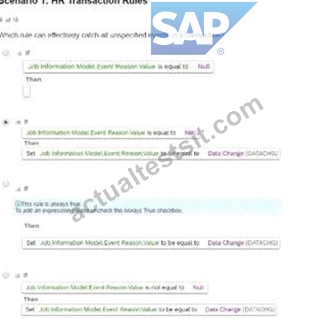
- A. Option C
- B. Option D
- C. Option A
- D. Option B
Answer: D
Explanation:
The rule inOption Beffectively captures all unspecified events in a transaction because:
* It sets theEvent Reason Valueto "Data Change" whenever the Event Reason Value isnull.
* This ensures that all unplanned or unspecified events are assigned a default action, which is crucial for maintaining data consistency and avoiding errors during transactions.
Scenario 1: HR Transaction Rules
NEW QUESTION # 28
According to SAP guidelines, what can you do in the event picklist when configuring events and event reasons? Note: There are 3 correct answers to this question.
- A. Change the external_code of an event.
- B. Change the labels.
- C. Change the status.
- D. Add a new language translation.
- E. Add a new event.
Answer: B,C,D
Explanation:
When configuring events and event reasons in SAP SuccessFactors, you can perform the following actions:
* A. Add a new language translation
* New language translations can be added for events and event reasons to support multilingual organizations.
* B. Change the status
* You can activate or deactivate events based on organizational needs.
* D. Change the labels
* Labels for events can be modified for better understanding and alignment with organizational terminology.
C: Change the external_code of an eventandE. Add a new eventare incorrect as external codes are immutable once created, and adding events requires admin-level access beyond event picklist configuration
NEW QUESTION # 29
In which order must you assign the rules?
- A. ERD1, ERD2, ERD3, WFD, ERD-Catch
- B. ERD-Calch, ERD1, ERD2, ERD3, WFD
- C. ERD1, ERD2, ERD3, ERD-Catch, WFD
- D. WFD, ERD1, ERD2, ERD3, ERD-Catch
Answer: C
NEW QUESTION # 30
Where do you enable the Incumbent of Parent Position option to filter positions in Hire, MSS Job Information and History?
- A. In Position Management Settings > Hierarchy Adaptation
- B. Position Management Settings > UI Customizing
- C. In Configure Object Definitions > Position
- D. In Manage Business Configuration > joblnfo
Answer: B
NEW QUESTION # 31
Which objects are supported in cross-entity business rules? Note: There are 2 correct answers to this question.
- A. Job Information
- B. Personal Information
- C. Pay Component Recurring
- D. Work Permit Information
Answer: A,C
Explanation:
Cross-entity business rules in SAP SuccessFactors Employee Central allow for data propagation and validation across different HRIS elements. The following objects are supported in cross-entity business rules:
* A. Pay Component Recurring
* This object pertains to regular, recurring payments such as salaries. Cross-entity rules can be configured to update or validate data between Pay Component Recurring and other entities like Job Information.
* D. Job Information
* This object contains details about an employee's job role, department, and other related information. Cross-entity rules can be used to ensure consistency between Job Information and other entities, such as Compensation Information.
Objects likeWork Permit InformationandPersonal Informationare not currently supported in cross-entity business rules. The focus of cross-entity rules is primarily on employment-related entities to maintain data integrity across core HR processes.
NEW QUESTION # 32
What must be done to ensure that you can use a custom generic (MDF) object for Employee Self- Service?
Note: There are 2 correct answers to this question.
- A. Set the externalCode field to Data Type = User.
- B. Create a Valid When association for the object.
- C. Set the externalName field to Data Type = User.
- D. Create one configuration UI for the object.
Answer: A,D
Explanation:
To enable a custom Generic (MDF) object for Employee Self-Service (ESS) in SAP SuccessFactors Employee Central, the following configurations are necessary:
* C. Create one configuration UI for the object.
* A Configuration UI (User Interface) must be created for the MDF object to define how users will interact with it. This UI facilitates data entry and management within the ESS framework.
SAP Learning Hub
* D. Set the externalCode field to Data Type = User.
* TheexternalCodefield should be set to the 'User' data type. This configuration ensures that the object is associated with specific user records, enabling personalized data management within ESS.
SAP Learning Hub
Options A and B are not required for enabling a custom MDF object for Employee Self-Service:
* A. Set the externalName field to Data Type = User.
* TheexternalNamefield typically holds descriptive information and does not need to be set to the
'User' data type for ESS functionality.
* B. Create a Valid When association for the object.
* While associations can define relationships between objects, a 'Valid When' association is not a prerequisite for enabling ESS capabilities for a custom MDF object.
NEW QUESTION # 33
An employee is changing their Last Name, so a CC workflow notification should be sent to their manager. When is the CC workflow notification sent out?
- A. When the employee initiates the workflow
- B. When the workflow is sent back by any approver
- C. When the workflow is approved by all approvers
- D. When the approvers decline the workflow
Answer: A
NEW QUESTION # 34
Your customer would like to autogenerate the Position Code to avoid manual entry. Which of the following are prerequisites to achieve this requirement?
Note: There are 3 correct answers to this question.
- A. Set a Business Rule using the Trigger Rules to Generate Assignment ID External with the event type onSave and assign it in Position > Save Rules
- B. Set the Position Code field as read-only in the Position Object Definition
- C. Set a Business Rule using the Rules for MDF Based Objects with the event type onSave and assign it in Position > code
- D. Set Position External Code Generation by On Save rule to Yes in Position Management Settings > General tab
- E. Set a Business Rule using the Rules for MDF Based Objects with the event type onSave and assign it in Position > Save Rules
Answer: A,B,D
Explanation:
To autogenerate the Position Code in Position Management, the following prerequisites must be fulfilled:
* B. Set a Business Rule using the Trigger Rules to Generate Assignment ID External with the event type onSave and assign it in Position > Save Rules:
* This rule ensures that the Position Code is automatically generated when a position is saved, based on the predefined logic in the business rule.
* C. Set Position External Code Generation by On Save rule to Yes in Position Management Settings > General tab:
* Enabling this setting ensures that the system allows automatic code generation based on the onSave rules defined in the Position Management module.
* E. Set the Position Code field as read-only in the Position Object Definition:
* Making the Position Code field read-only prevents manual entry, ensuring that the code is exclusively autogenerated by the system.
These settings align with best practices in automating Position Code generation and reducing manual input errors.
NEW QUESTION # 35
Which of the following are features of the clean core dashboard? Note: There are 2 correct answers to this question.
- A. It can be used in all SAP S/4HANA Cloud editions.
- B. Customers can use the dashboard in the dev, test, and production tenants.
- C. Customers can grant access to the dashboard to partners.
- D. It can be accessed by using SAP For Me.
Answer: C,D
Explanation:
Theclean core dashboardoffers tools to monitor and maintain clean core operations.
* Access via SAP For Me: The dashboard can be reached through theSAP For Meportal, a customer- centric interface for managing SAP environments.
* Partner Access: Customers can grant partners access to the clean core dashboard, allowing collaborative management and monitoring.
* The dashboard's functionality in specific tenants (like dev, test, production) or availability across all SAP S/4HANA Cloud editions depends on the specific system configurations.
NEW QUESTION # 36
What does SAP SuccessFactors recommend when you create custom associations between foundation objects (FO)?
- A. All custom associations should be built as one-to-one.
- B. All custom associations should be built between an XML FO and another XML FO.
- C. All custom associations should be built between an MDF FO and another MDF FO.
- D. All custom associations should be built as one-to-many.
Answer: D
Explanation:
SAP SuccessFactors recommends that all custom associations between foundation objects (FO) be built as one-to-many. This configuration reflects real-world organizational structures where a single entity, such as a department, can be associated with multiple positions or employees. Implementing one-to-many associations ensures flexibility and scalability in the system, allowing for accurate representation of complex organizational relationships.
NEW QUESTION # 37
Which of the following are features of the clean core dashboard? Note: There are 2 correct answers to this question.
- A. It can be used in all SAP S/4HANA Cloud editions.
- B. Customers can use the dashboard in the dev, test, and production tenants.
- C. Customers can grant access to the dashboard to partners.
- D. It can be accessed by using SAP For Me.
Answer: C,D
NEW QUESTION # 38
In which cases should the value for CREATE Respects Target Criteria be set to Yes in the Position object definition? Note: There are 2 correct answers to this question.
- A. To restrict access to create positions from Manage Positions
- B. To restrict access to create lower-level positions from the Position Org Chart
- C. To restrict access at the field level when creating positions
- D. To restrict access to create positions based on the granted user's target population
Answer: B,D
NEW QUESTION # 39
You need to create a one-to-many association from Location to Legal Entity. You also need to configure filtering of the Location field based on the Company field in the Job Information block.
What do you need to add to the data models? Note: There are 2 correct answers to this question.
- A. <field-criteria> as part of <hris-field="company">
- B. <field-criteria> as part of <hris-field="location">
- C. <association> as part of <hris-element id="jobInfo">
- D. <association> as part of <hris-element id="location">
Answer: B,D
NEW QUESTION # 40
The manager has the ability to change the salary during the workflow. Which of the following options do you need to select for a new workflow to be triggered when the manager edits the salary?
- A. Edit with Route Change
- B. Edit without Route Change
- C. No edit
- D. Edit Attachment Only
Answer: A
NEW QUESTION # 41
Your customer would like to auto generate the Position Code to avoid manual entry.
Which of the following are prerequisites to achieve this requirement? Note: There are 3 correct answers to this question.
- A. Set the Position Code field as read-only in the Position Object Definition
- B. Set a Business Rule using the Rules for MDF Based Objects with the event type onSave and assign it in Position > code
- C. Set Position External Code Generation by On Save rule to Yes in Position Management Settings > General tab
- D. Set a Business Rule using the Trigger Rules to Generate Assignment ID External with the event type onSave and assign it in Position > Save Rules
- E. Set a Business Rule using the Rules for MDF Based Objects with the event type onSave and assign it in Position > Save Rules
Answer: A,C,E
NEW QUESTION # 42
Fields in the termination screen are configured in which hris-element?
- A. Compensation Information
- B. Employment Information
- C. Personal Information
- D. Job Information
Answer: B
Explanation:
Fields displayed on the termination screen are configured in theEmployment InformationHRIS element. This element contains employment-specific details, such as hire dates, termination dates, and reasons for termination.
Other HRIS elements likePersonal Information,Compensation Information, andJob Informationdo not manage termination-specific configurations
NEW QUESTION # 43
Your customer needs to set up a workflow to direct approval processes to the head of a business unit. Which approver type do you use?
- A. Dynamic Group
- B. Manager
- C. Dynamic Role
- D. Role
Answer: C
NEW QUESTION # 44
In a generic object with a picklist field, what must be entered in the Valid Values Source?
- A. Picklist Code
- B. Picklist Value ID
- C. Picklist Value External Code
- D. Legacy Picklist ID
Answer: B
NEW QUESTION # 45
An HR admin/Global Mobility person must create a transfer for an employee. The employee will be moving from Position A in Team A to Position B in Team B. Both managers will have to approve the transfer.
How do you configure a two-step workflow so that the approval goes first to the current manager and second to the future manager?
- A. By selecting in Step 1. Position Relationship - Parent Parent Position - Source
*By selecting in Step 2: Position Relationship - Parent Position - Target - B. By selecting in Step 1: Role - Self-Source
*By selecting in Step 2. Role- Manager - Target - C. By selecting in Step 1: Role - Manager - Source
*By selecting in Slep 2. Role-Manager Manager - Target - D. By selecting in Step 1. Role-Manager - Source
*By selecting in Step 2: Role - Manager - Target
Answer: D
Explanation:
Scenario 2: Approvals for Self-Service
To configure a two-step workflow where the approval first goes to the current manager and then to the future manager, you must set the following in the workflow:
* Step 1: Role - Manager - Source (current manager of the employee).
* Step 2: Role - Manager - Target (future manager of the employee).This setup ensures that the workflow sequentially routes approval to both the current and future managers.
NEW QUESTION # 46
Which of the following standard behaviors in Position Management can be set differently using Position Types? Note: There are 3 correct answers to this question.
- A. Transfer incumbents of the lower-level positions to a new manager if the current manager leaves their position
- B. Respect workflow at Copy Position in Position Organizational Chart
- C. Define a specific transition period for a group of positions
- D. Set or reset TBH status if an incumbent's FTE is changed
- E. Trigger workflows on Job Information if the position changes are synchronized to the incumbents
Answer: B,D,E
NEW QUESTION # 47
......
C-THR81-2405 dumps review - Professional Quiz Study Materials: https://protechtraining.actualtestsit.com/SAP/C-THR81-2405-exam-prep-dumps.html