

The New CS0-003 2025 Updated Verified Study Guides & Best Courses
Authentic CS0-003 Exam Dumps PDF - 2025 Updated
CompTIA Cybersecurity Analyst (CySA+) Certification is recognized by employers worldwide and is in high demand. CompTIA Cybersecurity Analyst (CySA+) Certification Exam certification demonstrates that the candidate has the skills and knowledge to protect against cybersecurity threats and incidents. CompTIA Cybersecurity Analyst (CySA+) Certification Exam certification is ideal for professionals who are looking to advance their careers in cybersecurity and want to demonstrate their expertise in this field.
NEW QUESTION # 344
An analyst receives an alert for suspicious IIS log activity and reviews the following entries:
2024-05-23
15:57:05 10.203.10.16 HEAT / - 80 - 10.203.10.17 DirBuster-1.0-RC1+(http://www.owasp.org/index.php
/Category:OWASP_DirBuster_Project)
...
Which of the following will the analyst infer from the logs?
- A. An attacker is cloning the website.
- B. An attacker is exfiltrating data from the network.
- C. An attacker is performing network lateral movement.
- D. An attacker is conducting reconnaissance of the website.
Answer: D
Explanation:
Comprehensive and Detailed Step-by-Step Explanation:The logs indicate that the OWASP DirBuster tool is being used. This tool is designed for directory brute-forcing to find hidden files or directories on a web server, which aligns with reconnaissance activities. The series of GET and HEAD requests further confirm directory and file enumeration attempts.
References:
* CompTIA CySA+ Study Guide (Chapter 4: Reconnaissance Techniques)
* CompTIA CySA+ Objectives (Domain 1.3 Tools and Techniques)
NEW QUESTION # 345
A security audit for unsecured network services was conducted, and the following output was generated: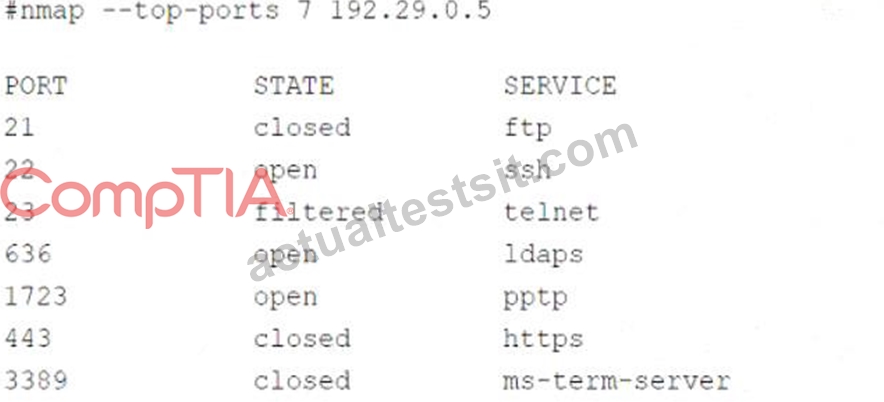
Which of the following services should the security team investigate further? (Select two).
- A. 0
- B. 1
- C. 2
- D. 3
- E. 4
- F. 5
Answer: A,E
Explanation:
The output shows the results of a port scan, which is a technique used to identify open ports and services running on a network host. Port scanning can be used by attackers to discover potential vulnerabilities and exploit them, or by defenders to assess the security posture and configuration of their network devices1 The output lists six ports that are open on the target host, along with the service name and version associated with each port. The service name indicates the type of application or protocol that is using the port, while the version indicates the specific release or update of the service. The service name and version can provide useful information for both attackers and defenders, as they can reveal the capabilities, features, and weaknesses of the service.
Among the six ports listed, two are particularly risky and should be investigated further by the security team:
port 23 and port 636.
Port 23 is used by Telnet, which is an old and insecure protocol for remote login and command execution.
Telnet does not encrypt any data transmitted over the network, including usernames and passwords, which makes it vulnerable to eavesdropping, interception, and modification by attackers. Telnet also has many known vulnerabilities that can allow attackers to gain unauthorized access, execute arbitrary commands, or cause denial-of-service attacks on the target host23 Port 636 is used by LDAP over SSL/TLS (LDAPS), which is a protocol for accessing and modifying directory services over a secure connection. LDAPS encrypts the data exchanged between the client and the server using SSL/TLS certificates, which provide authentication, confidentiality, and integrity. However, LDAPS can also be vulnerable to attacks if the certificates are not properly configured, verified, or updated.
For example, attackers can use self-signed or expired certificates to perform man-in-the-middle attacks, spoofing attacks, or certificate revocation attacks on LDAPS connections.
Therefore, the security team should investigate further why port 23 and port 636 are open on the target host, and what services are running on them. The security team should also consider disabling or replacing these services with more secure alternatives, such as SSH for port 23 and StartTLS for port 6362
NEW QUESTION # 346
An organization has deployed a cloud-based storage system for shared data that is in phase two of the data life cycle. Which of the following controls should the security team ensure are addressed? (Choose two.)
- A. Backups
- B. Data classification
- C. Data loss prevention
- D. Encryption
- E. Data destruction
- F. Access controls
Answer: D,F
NEW QUESTION # 347
A security analyst receives an alert for suspicious activity on a company laptop An excerpt of the log is shown below: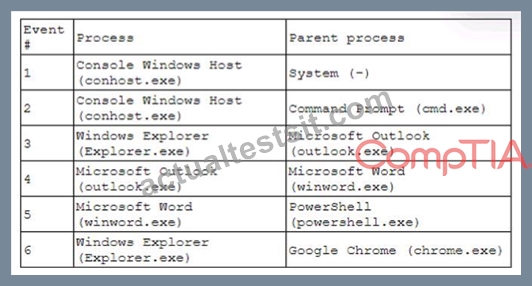
Which of the following has most likely occurred?
- A. A web browser vulnerability was exploited.
- B. A credential-stealing website was visited.
- C. A phishing link in an email was clicked
- D. An Office document with a malicious macro was opened.
Answer: D
Explanation:
An Office document with a malicious macro was opened is the most likely explanation for the suspicious activity on the company laptop, as it reflects the common technique of using macros to execute PowerShell commands that download and run malware. A macro is a piece of code that can automate tasks or perform actions in an Office document, such as a Word file or an Excel spreadsheet. Macros can be useful and legitimate, but they can also be abused by threat actors to deliver malware or perform malicious actions on the system. A malicious macro can be embedded in an Office document that is sent as an attachment in a phishing email or hosted on a compromised website. When the user opens the document, they may be prompted to enable macros or content, which will trigger the execution of the malicious code. The malicious macro can then use PowerShell, which is a scripting language and command-line shell that is built into Windows, to perform various tasks, such as downloading and running malware from a remote URL, bypassing security controls, or establishing persistence on the system. The log excerpt shows that PowerShell was used to download a string from a URL using the WebClient.DownloadString method, which is a common way to fetch and execute malicious code from the internet. The log also shows that PowerShell was used to invoke an expression (iex) that contains obfuscated code, which is another common way to evade detection and analysis.
The other options are not as likely as an Office document with a malicious macro was opened, as they do not match the evidence in the log excerpt. A credential-stealing website was visited is possible, but it does not explain why PowerShell was used to download and execute code from a URL. A phishing link in an email was clicked is also possible, but it does not explain what happened after the link was clicked or how PowerShell was involved. A web browser vulnerability was exploited is unlikely, as it does not explain why PowerShell was used to download and execute code from a URL.
NEW QUESTION # 348
A security analyst reviews the following extract of a vulnerability scan that was performed against the web server:
Which of the following recommendations should the security analyst provide to harden the web server?
- A. Disable tcp_wrappers.
- B. Remove the version information on http-server-header.
- C. Delete the /wp-login.php folder.
- D. Close port 22.
Answer: B
Explanation:
The vulnerability scan shows that the version information is visible in the http-server-header, which can be exploited by attackers to identify vulnerabilities specific to that version. Removing or obfuscating this information can enhance security.
References: CompTIA CySA+ CS0-003 Certification Study Guide, Chapter 4: Vulnerability Management, page 172; CompTIA CySA+ Study Guide: Exam CS0-003, 3rd Edition, Chapter 5: Vulnerability Management, page 223.
NEW QUESTION # 349
A security analyst has identified outgoing network traffic leaving the enterprise at odd times. The traffic appears to pivot across network segments and target domain servers. The traffic is then routed to a geographic location to which the company has no association. Which of the following best describes this type of threat?
- A. Insider threat
- B. Hacktivist
- C. Zombie
- D. Nation-state actor
Answer: D
NEW QUESTION # 350
During an incident, a security analyst discovers a large amount of Pll has been emailed externally from an employee to a public email address. The analyst finds that the external email is the employee's personal email. Which of the following should the analyst recommend be done first?
- A. Configure a deny rule on the firewall.
- B. Enable filtering on the web proxy.
- C. Disable the public email access with CASB.
- D. Place a legal hold on the employee's mailbox.
Answer: D
Explanation:
Placing a legal hold on the employee's mailbox is the best action to perform first, as it preserves all mailbox content, including deleted items and original versions of modified items, for potential legal or forensic purposes. A legal hold is a feature that allows an administrator to retain mailbox data for a user indefinitely or for a specified period, regardless of the user's actions or retention policies. A legal hold can be applied to a mailbox using Litigation Hold or In-Place Hold in Exchange Server or Exchange Online. A legal hold can help to ensure that evidence of data exfiltration or other malicious activities is not lost or tampered with, and that the organization can comply with any legal or regulatory obligations. The other actions are not as urgent or effective as placing a legal hold on the employee's mailbox, as they do not address the immediate threat of data loss or compromise. Enabling filtering on the web proxy may help to prevent some types of data exfiltration or malicious traffic, but it does not help to recover or preserve the data that has already been emailed externally. Disabling the public email access with CASB (Cloud Access Security Broker) may help to block or monitor the use of public email services by employees, but it does not help to recover or preserve the data that has already been emailed externally.
Configuring a deny rule on the firewall may help to block or monitor the network traffic from the employee's laptop, but it does not help to recover or preserve the data that has already been emailed externally.
NEW QUESTION # 351
Which of the following types of controls defines placing an ACL on a file folder?
- A. Managerial control
- B. Operational control
- C. Technical control
- D. Confidentiality control
Answer: C
Explanation:
Technical controls enforce confidentiality, integrity, and availability in the digital space. Examples of technical security controls include firewall rules, access control lists, intrusion prevention systems, and encryption.
NEW QUESTION # 352
While reviewing web server logs, an analyst notices several entries with the same time stamps, but all contain odd characters in the request line. Which of the following steps should be taken next?
- A. Utilize the correct attack framework and determine what the incident response will consist of.
- B. Determine what attack the odd characters are indicative of
- C. Shut the network down immediately and call the next person in the chain of command.
- D. Notify the local law enforcement for incident response
Answer: B
Explanation:
Determining what attack the odd characters are indicative of is the next step that should be taken after reviewing web server logs and noticing several entries with the same time stamps, but all contain odd characters in the request line. This step can help the analyst identify the type and severity of the attack, as well as the possible source and motive of the attacker. The odd characters in the request line may indicate that the attacker is trying to exploit a vulnerability or inject malicious code into the web server or application, such as SQL injection, cross-site scripting, buffer overflow, or command injection. The analyst can use tools and techniques such as log analysis, pattern matching, signature detection, or threat intelligence to determine what attack the odd characters are indicative of, and then proceed to the next steps of incident response, such as containment, eradication, recovery, and lessons learned. Official References:
https://partners.comptia.org/docs/default-source/resources/comptia-cysa-cs0-002-exam-objectives
https://www.comptia.org/certifications/cybersecurity-analyst
https://www.comptia.org/blog/the-new-comptia-cybersecurity-analyst-your-questions-answered
NEW QUESTION # 353
An analyst has been asked to validate the potential risk of a new ransomware campaign that the Chief Financial Officer read about in the newspaper. The company is a manufacturer of a very small spring used in the newest fighter jet and is a critical piece of the supply chain for this aircraft. Which of the following would be the best threat intelligence source to learn about this new campaign?
- A. Blogs/forums
- B. Deep/dark web
- C. Cybersecuritv incident response team
- D. Information sharing organization
Answer: D
Explanation:
Explanation
An information sharing organization is a group or network of organizations that share threat intelligence, best practices, or lessons learned related to cybersecurity issues or incidents. An information sharing organization can help security analysts learn about new ransomware campaigns or other emerging threats, as well as get recommendations or guidance on how to prevent, detect, or respond to them. An information sharing organization can also help security analysts collaborate or coordinate with other organizations in the same industry or region that may face similar threats or challenges.
NEW QUESTION # 354
During an incident, some loCs of possible ransomware contamination were found in a group of servers in a segment of the network. Which of the following steps should be taken next?
- A. Remediation
- B. Reimaging
- C. Preservation
- D. Isolation
Answer: D
Explanation:
Isolation is the first step to take after detecting some indicators of compromise (IoCs) of possible ransomware contamination. Isolation prevents the ransomware from spreading to other servers or segments of the network, and allows the security team to investigate and contain the incident. Isolation can be done by disconnecting the infected servers from the network, blocking the malicious traffic, or applying firewall rules12.
NEW QUESTION # 355
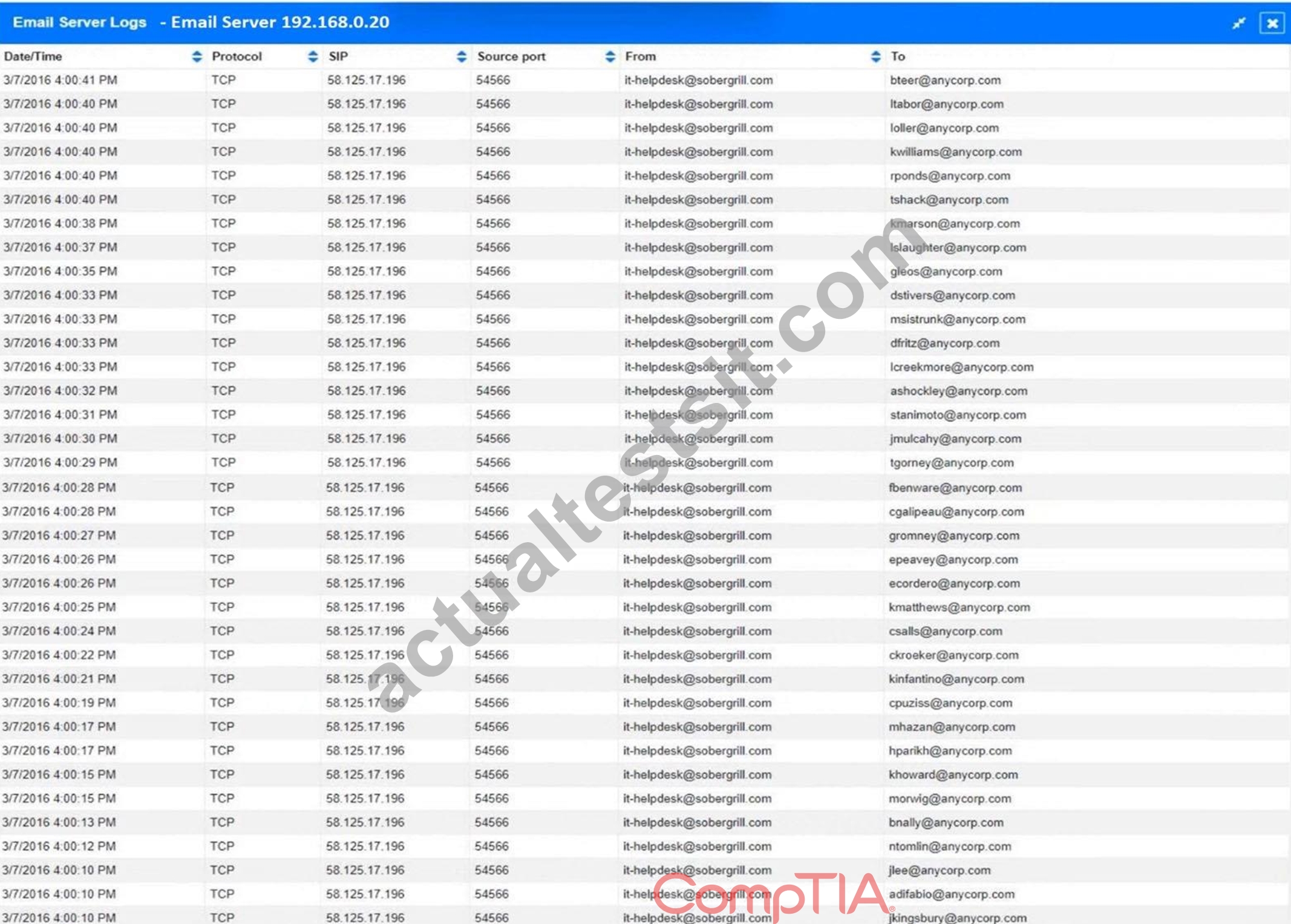
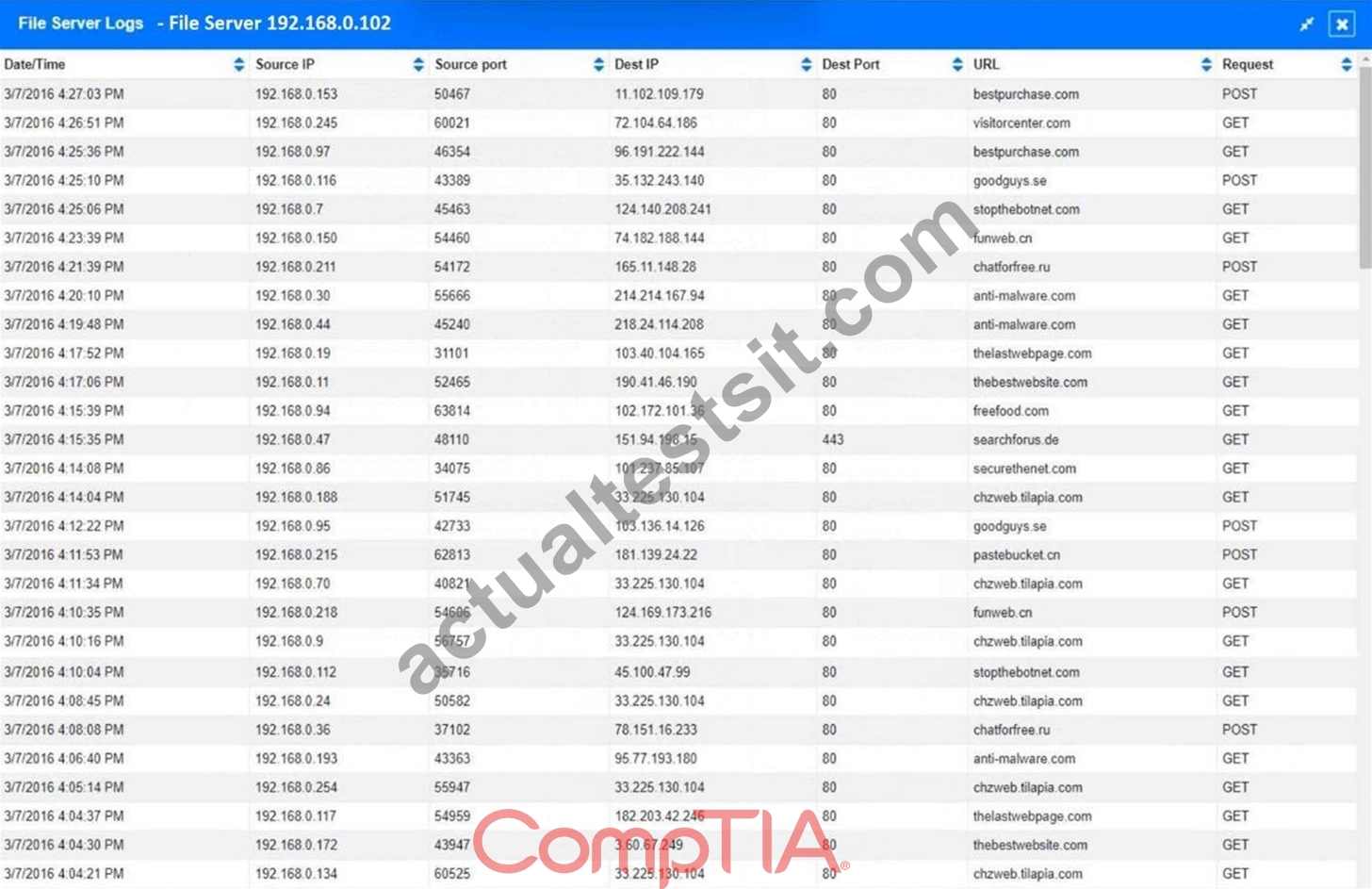
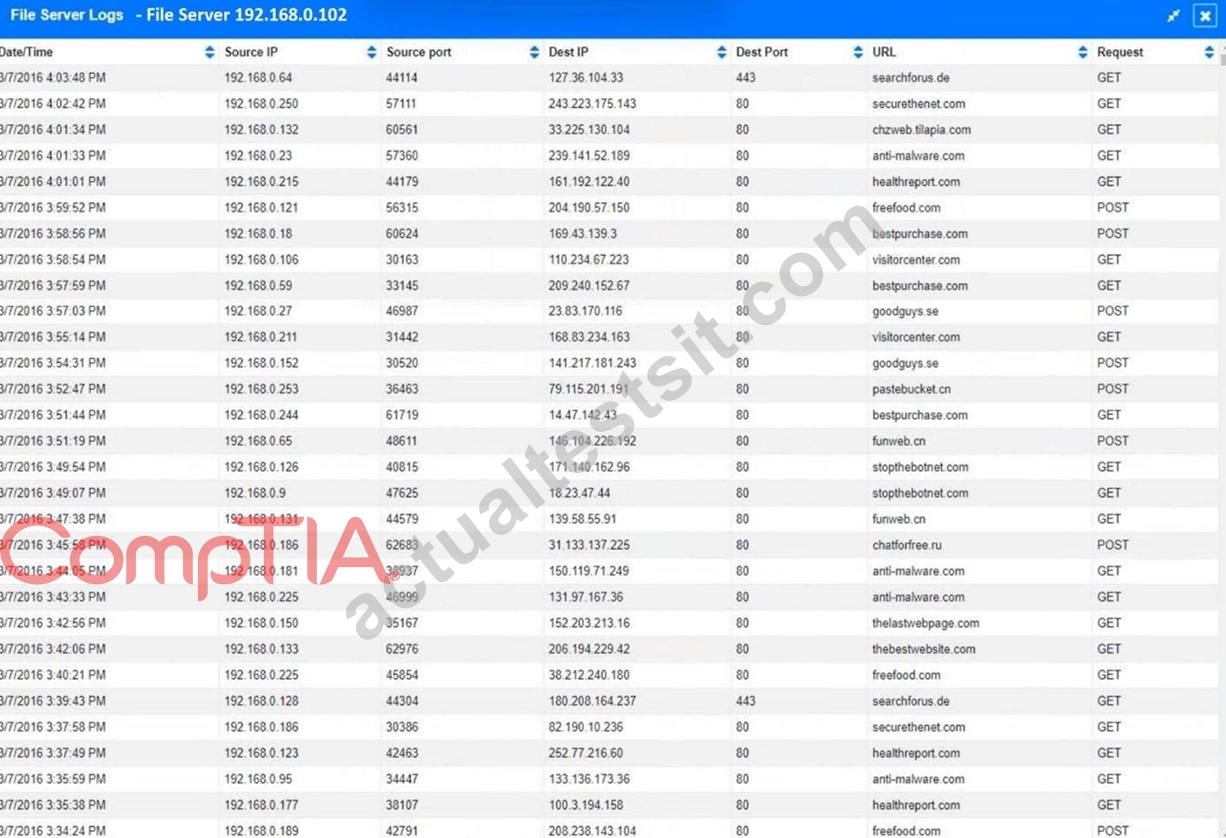
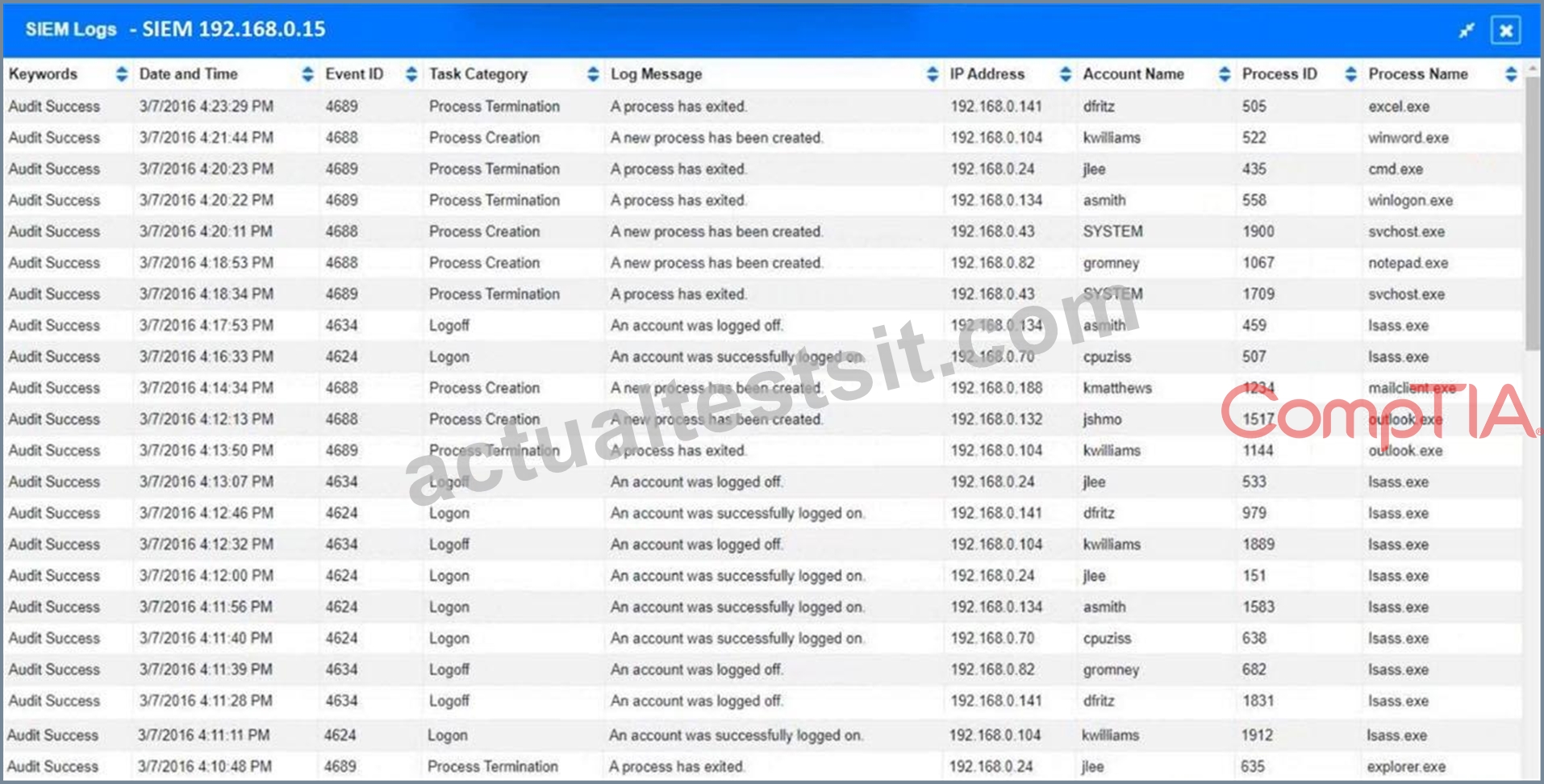
SIMULATION
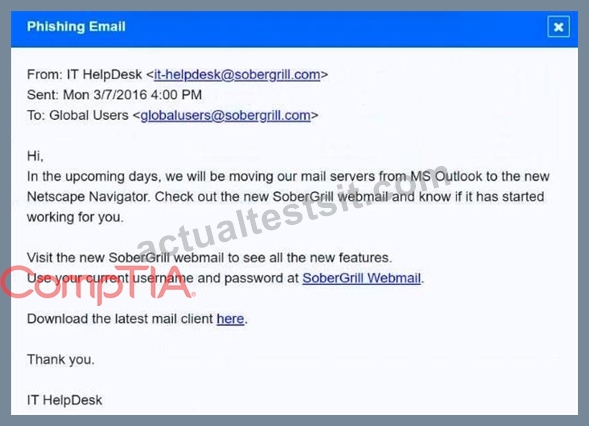
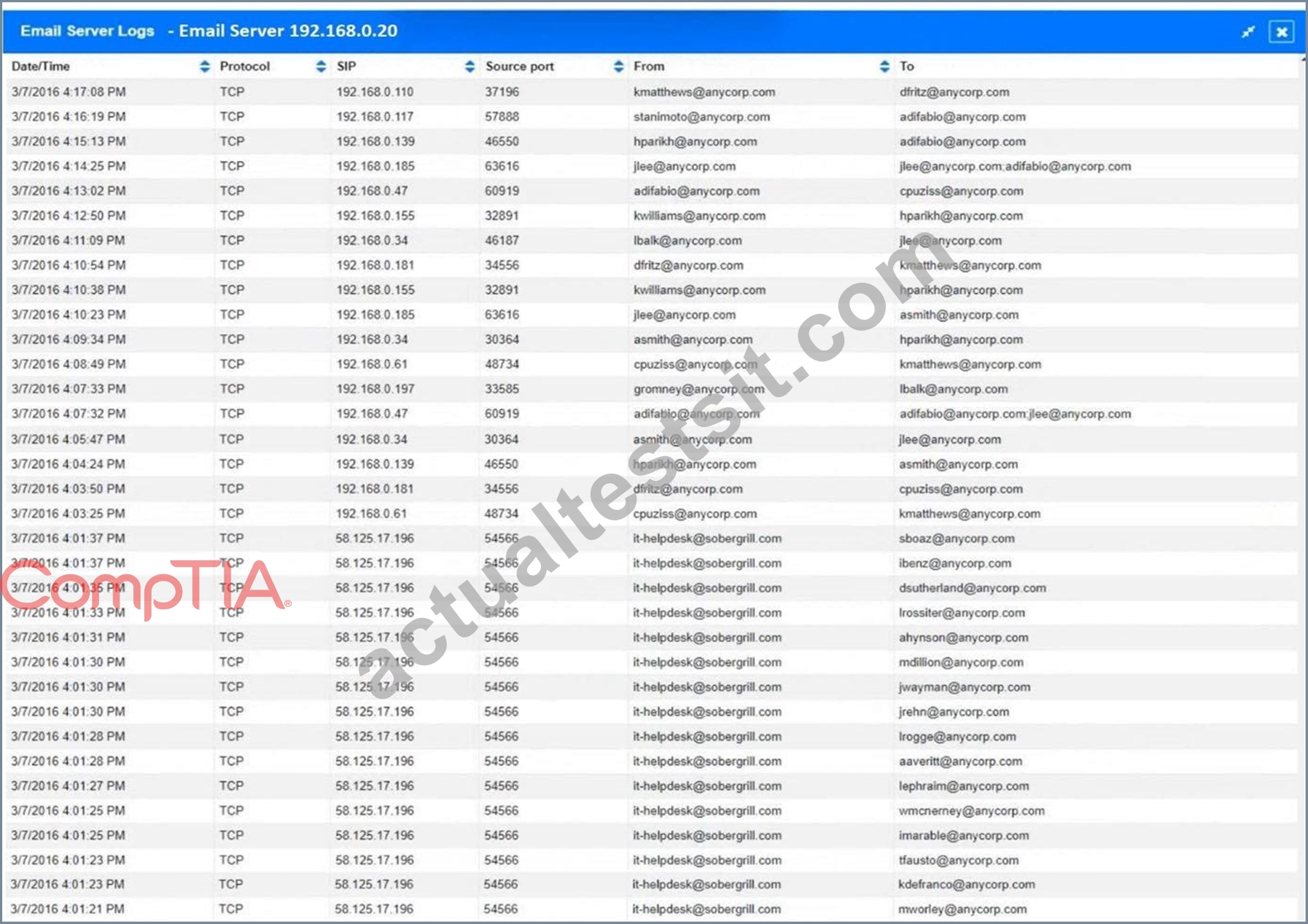
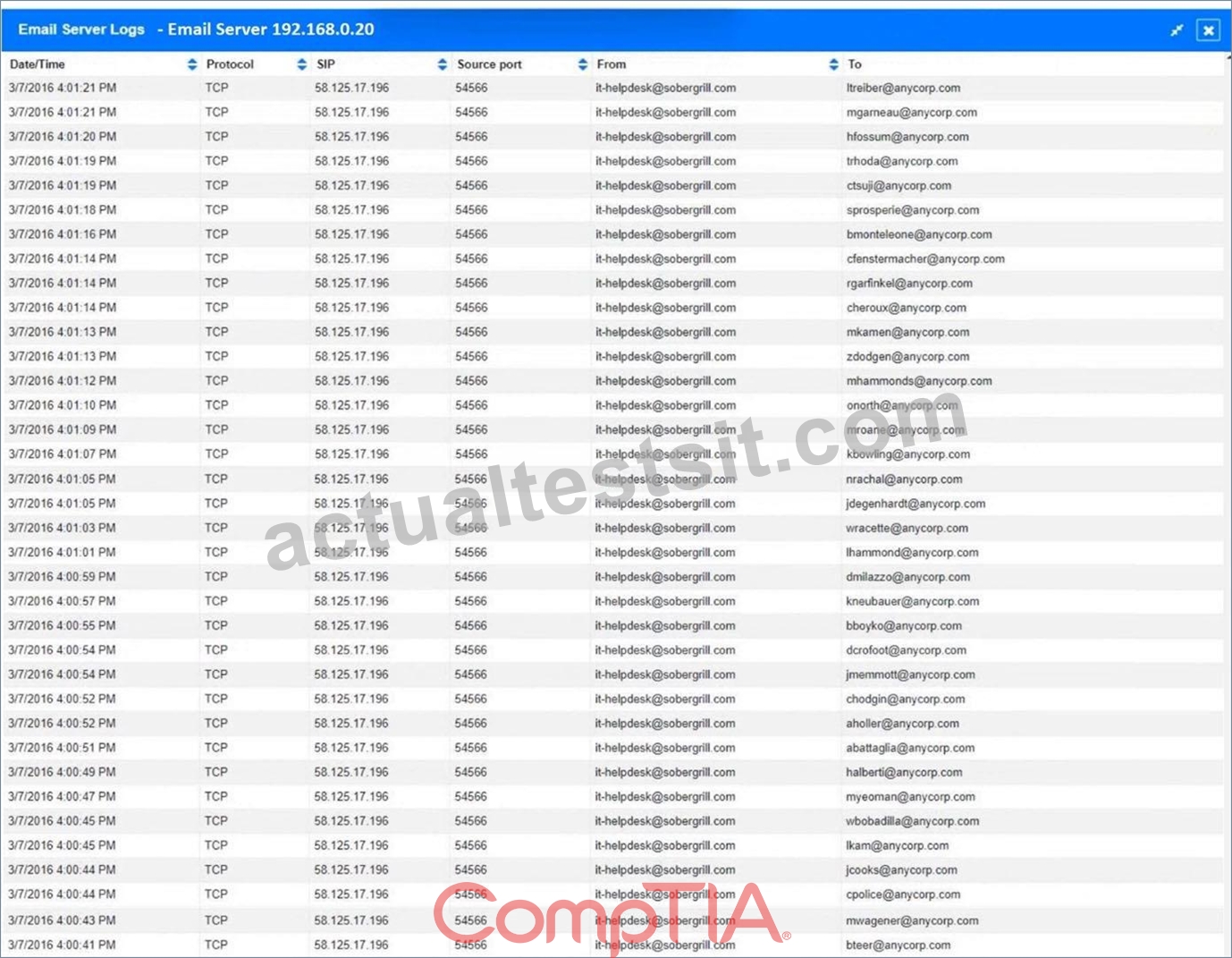
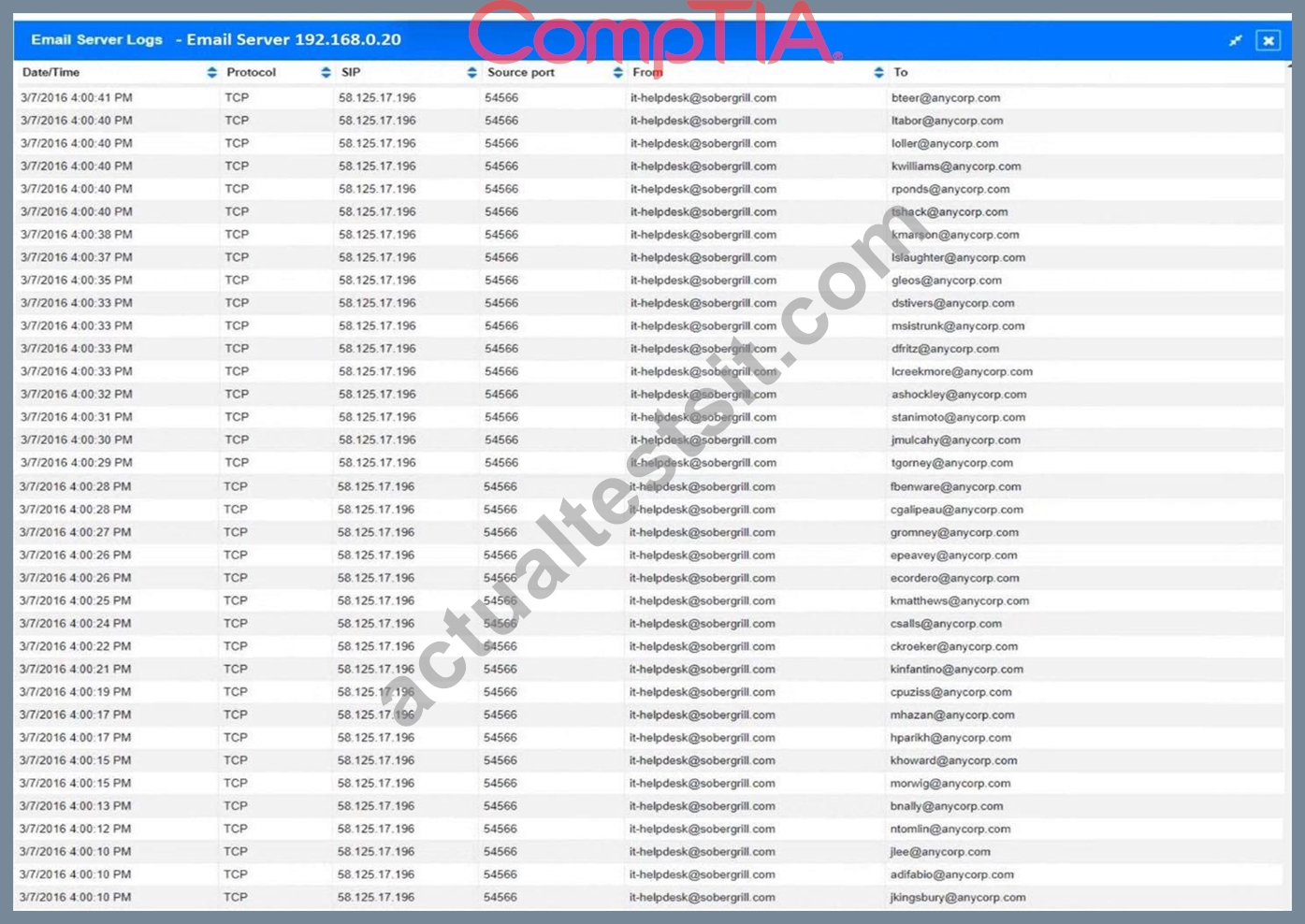
Approximately 100 employees at your company have received a phishing email. As a security analyst, you have been tasked with handling this situation.
INSTRUCTIONS
Review the information provided and determine the following:
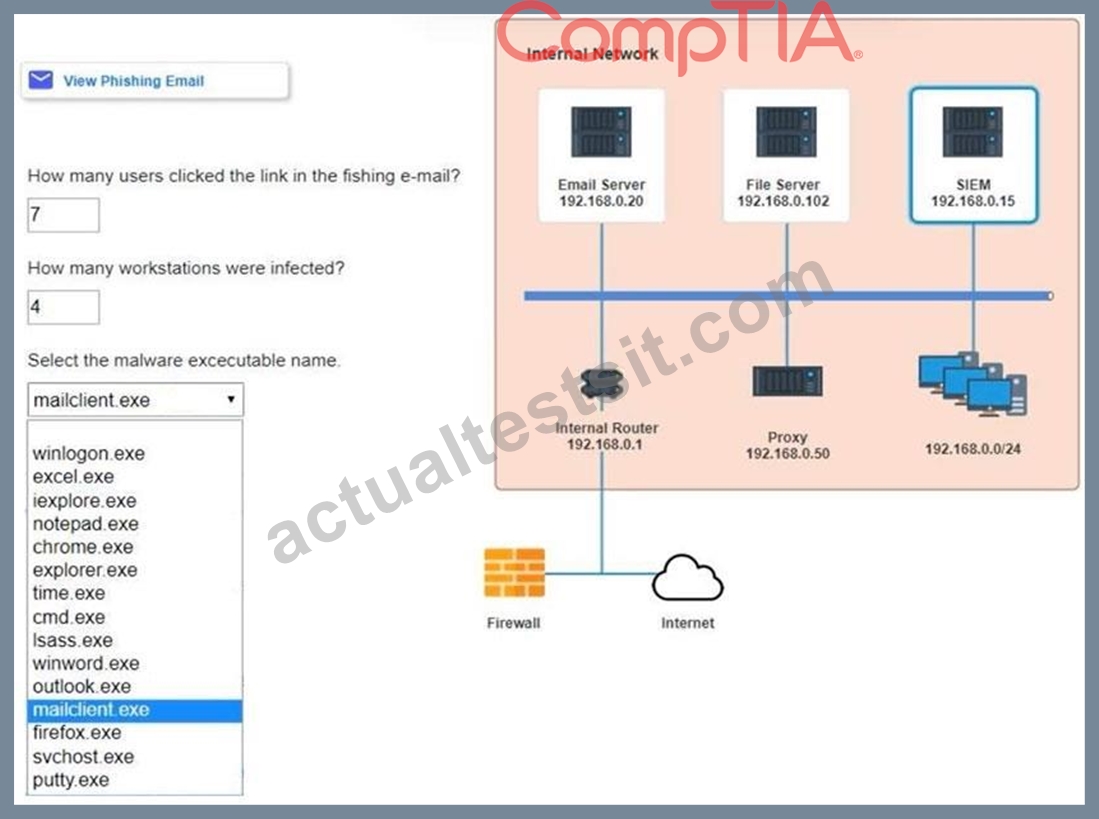
1. How many employees clicked on the link in the phishing email?
2. On how many workstations was the malware installed?
3. What is the executable file name of the malware?
If at any time you would like to bring back the initial state of the simulation, please click the Reset All button.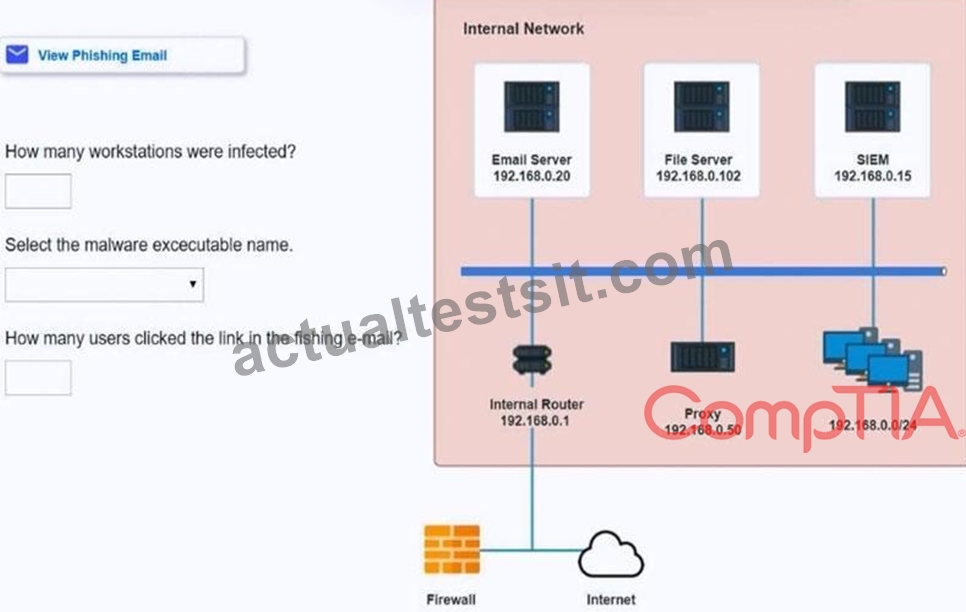
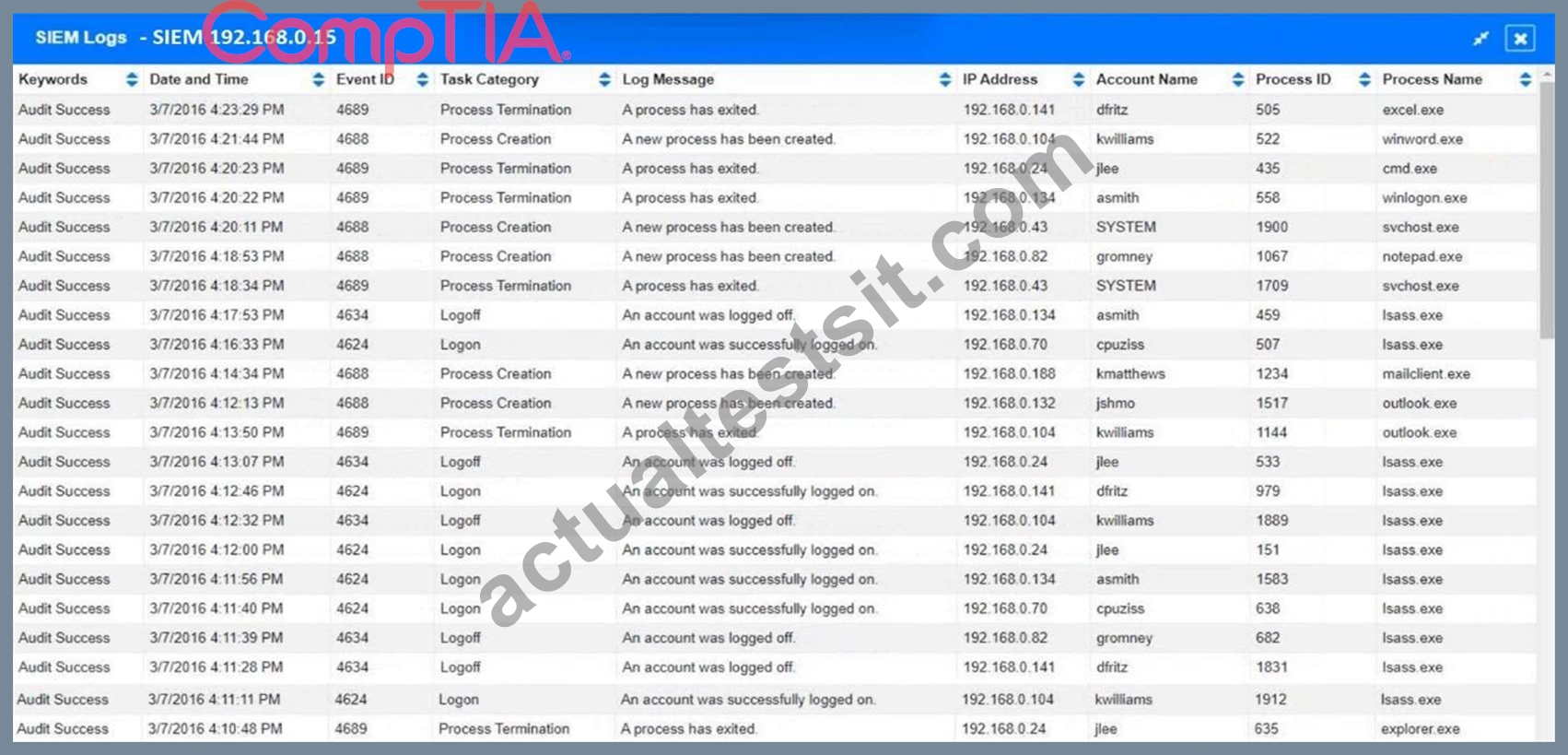
Answer:
Explanation: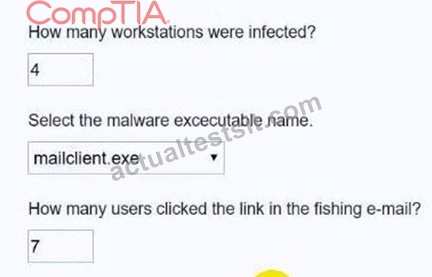
NEW QUESTION # 356
A Chief Information Security Officer wants to map all the attack vectors that the company faces each day.
Which of the following recommendations should the company align their security controls around?
- A. MITRE ATT&CK
- B. Diamond Model Of Intrusion Analysis
- C. OWASP
- D. OSSTMM
Answer: A
Explanation:
Explanation
The correct answer is D. MITRE ATT&CK.
MITRE ATT&CK is a framework that maps the tactics, techniques, and procedures (TTPs) of various threat actors and groups, based on real-world observations and data. MITRE ATT&CK can help a Chief Information Security Officer (CISO) to map all the attack vectors that the company faces each day, as well as to align their security controls around the most relevant and prevalent threats. MITRE ATT&CK can also help the CISO to assess the effectiveness and maturity of their security posture, as well as to identify and prioritize the gaps and improvements .
The other options are not the best recommendations for mapping all the attack vectors that the company faces each day. OSSTMM (Open Source Security Testing Methodology Manual) (A) is a methodology that provides guidelines and best practices for conducting security testing and auditing, but it does not map the TTPs of threat actors or groups. Diamond Model of Intrusion Analysis (B) is a model that analyzes the relationships and interactions between four elements of an intrusion: adversary, capability, infrastructure, and victim. The Diamond Model can help understand the characteristics and context of an intrusion, but it does not map the TTPs of threat actors or groups. OWASP (Open Web Application Security Project) is a project that provides resources and tools for improving the security of web applications, but it does not map the TTPs of threat actors or groups.
NEW QUESTION # 357
A recent penetration test discovered that several employees were enticed to assist attackers by visiting specific websites and running downloaded files when prompted by phone calls. Which of the following would best address this issue?
- A. Disabling all staff members' ability to run downloaded applications
- B. Ensuring that malicious websites cannot be visited
- C. Increasing training and awareness for all staff
- D. Blocking all scripts downloaded from the internet
Answer: C
Explanation:
Increasing training and awareness for all staff is the best way to address the issue of employees being enticed to assist attackers by visiting specific websites and running downloaded files when prompted by phone calls. This issue is an example of social engineering, which is a technique that exploits human psychology and behavior to manipulate people into performing actions or divulging information that benefit the attackers. Social engineering can take many forms, such as phishing, vishing, baiting, quid pro quo, or impersonation. The best defense against social engineering is to educate and train the staff on how to recognize and avoid common social engineering tactics, such as:
Verifying the identity and legitimacy of the caller or sender before following their instructions or clicking on any links or attachments Being wary of unsolicited or unexpected requests for information or action, especially if they involve urgency, pressure, or threats Reporting any suspicious or anomalous activity to the security team or the appropriate authority Following the organization's policies and procedures on security awareness and best practices Official Reference:
https://partners.comptia.org/docs/default-source/resources/comptia-cysa-cs0-002-exam-objectives
https://www.comptia.org/certifications/cybersecurity-analyst
https://www.comptia.org/blog/the-new-comptia-cybersecurity-analyst-your-questions-answered
NEW QUESTION # 358
A security analyst must preserve a system hard drive that was involved in a litigation request Which of the following is the best method to ensure the data on the device is not modified?
- A. Protect the device with a complex password.
- B. Encrypt the device to ensure confidentiality of the data.
- C. Generate a hash value and make a backup image.
- D. Perform a memory scan dump to collect residual data.
Answer: C
Explanation:
Generating a hash value and making a backup image is the best method to ensure the data on the device is not modified, as it creates a verifiable copy of the original data that can be used for forensic analysis. Encrypting the device, protecting it with a password, or performing a memory scan dump do not prevent the data from being altered or deleted. Verified References: CompTIA CySA+ CS0-002 Certification Study Guide, page
3291
NEW QUESTION # 359
......
The CompTIA CS0-003 exam objectives for CS0-003 are divided into five domains, namely threat management, vulnerability management, security architecture and toolsets, cyber incident response, and compliance and assessment. The threat management domain covers the identification of various security threats and the implementation of security policies to prevent them from happening. The vulnerability management domain involves understanding the vulnerabilities present in the network and applying preventive measures to ensure that they are secure. The security architecture and toolsets domain deals with understanding and implementing the various tools and technologies used in cybersecurity.
Get Prepared for Your CS0-003 Exam With Actual 622 Questions: https://protechtraining.actualtestsit.com/CompTIA/CS0-003-exam-prep-dumps.html