

Updated Nov-2025 Test Engine to Practice CNX-001 Test Questions
CNX-001 Real Exam Questions Test Engine Dumps Training With 86 Questions
NEW QUESTION # 12
A company is experiencing Wi-Fi performance issues. Three Wi-Fi networks are available, each running on the 2.4 GHz band and on the same channel. Connecting to each Wi-Fi network yields slow performance.
Which of the following channels should the networks be configured to?
- A. Channel 2, Channel 4, and Channel 9
- B. Channel 1, Channel 6, and Channel 11
- C. Channel 1, Channel 2, and Channel 3
- D. Channel 3, Channel 5, and Channel 10
Answer: B
Explanation:
Comprehensive and Detailed Explanation From Exact Extract:
In the 2.4 GHz Wi-Fi band, channels overlap due to how the frequency spectrum is divided. To prevent co- channel and adjacent-channel interference, only non-overlapping channels should be used. According to the IEEE 802.11 standard and best practices outlined in the CompTIA CloudNetX CNX-001 Study Guide under
"Wireless Network Optimization," the three non-overlapping channels in the 2.4 GHz band are:
* Channel 1 (2.412 GHz)
* Channel 6 (2.437 GHz)
* Channel 11 (2.462 GHz)
These channels are spaced far enough apart to avoid interference, even when operating in close proximity.
Using overlapping channels (as in options A, B, and D) causes signal degradation and poor performance due to increased contention and retransmissions.
Relevant Extract from CompTIA CloudNetX CNX-001:
"Wi-Fi networks operating on the 2.4 GHz band should use channels 1, 6, and 11 to ensure maximum throughput and minimal interference in environments with multiple access points."
NEW QUESTION # 13
A SaaS company's new service currently is being provided through four servers. The company's end users are having connection issues, which is affecting about 25% of the connections. Which of the following is most likely the root cause of this issue?
- A. Load balancing is configured with a health check in front of these servers, and one of these servers is unavailable.
- B. The service is using round-robin load balancing through a DNS server with one server down.
- C. The service is using weighted load balancing with 40% of the traffic on server A, 20% on server B,
20% on server C, and server D is down. - D. The service is using a least-connection load-balancing method with one server down.
Answer: B
Explanation:
Comprehensive and Detailed Explanation From Exact Extract:
Round-robin DNS is a simplistic form of load balancing that does not perform health checks. If one of the four servers is down, DNS will still resolve its IP to 25% of users, resulting in failed connections. This matches the symptom of 25% failure rate - 1 out of 4.
Relevant Extract from CompTIA CloudNetX CNX-001 Study Guide - under "Load Balancing Techniques and Availability":
"Round-robin DNS distributes requests without regard for health status. Without external health checks, failed servers will continue to receive traffic, leading to partial service disruptions." Other options:
* B. The percentages do not align with a 25% failure rate.
* C. Least-connection algorithms usually have integrated health checks.
* D. If health checks are active, the load balancer would not forward requests to a failed server.
NEW QUESTION # 14
An architecture team needs to unify all logging and performance monitoring used by global applications across the enterprise to perform decision-making analytics. Which of the following technologies is the best way to fulfill this purpose?
- A. Data lake
- B. CIEM
- C. Content delivery network
- D. Relational database
Answer: A
Explanation:
Comprehensive and Detailed Explanation From Exact Extract:
A data lake is ideal for aggregating structured and unstructured data at scale. It supports storage and analysis of logs, performance metrics, and other telemetry data from various sources. Data lakes enable advanced analytics and machine learning for decision support.
Relevant Extract from CompTIA CloudNetX CNX-001 Study Guide - under "Data Aggregation and Analytics":
"Data lakes allow storage and analysis of high-volume, diverse data types, including logs and monitoring data. They support enterprise-wide visibility and strategic decision-making." Other options:
* A. Relational databases are optimized for structured data and are less scalable for log aggregation.
* B. CDNs deliver content, not used for data aggregation.
* C. CIEM (Cloud Infrastructure Entitlement Management) governs cloud permissions, not logging.
NEW QUESTION # 15
Application development team users are having issues accessing the database server within the cloud environment. All other users are able to use SSH to access this server without issues. The network architect reviews the following information to troubleshoot the issue: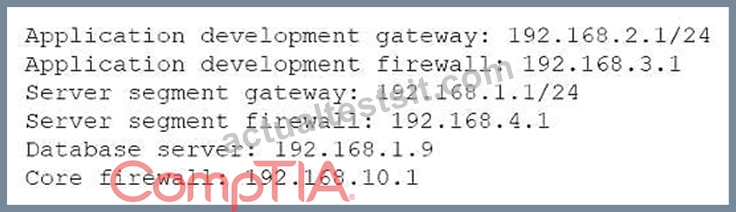
Traceroute output from an application developer's machine with the assigned IP 192.168.2.7: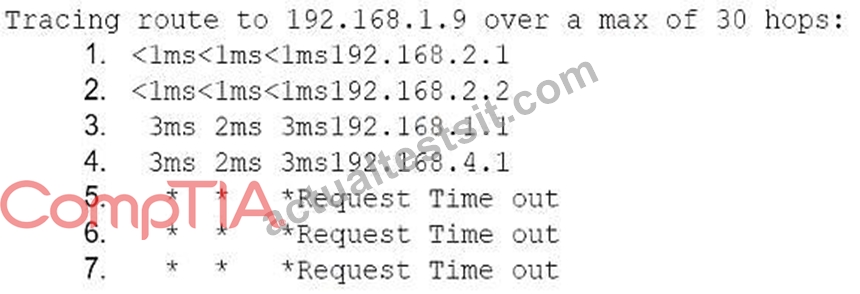
* Application development gateway: 192.168.2.1/24
* Server segment gateway: 192.168.1.1/24
* Database server: 192.168.1.9
* Application developer machine IP: 192.168.2.7
* Traceroute ends at hop 4: 192.168.4.1 (server segment firewall), then times out Which of the following is the most likely cause of the issue?
- A. The server segment firewall is dropping the traffic.
- B. The server segment gateway is having bandwidth issues.
- C. The core firewall is blocking the traffic.
- D. Network security groups do not have the correct outbound rule configured.
Answer: A
Explanation:
Comprehensive and Detailed Explanation From Exact Extract:
The traceroute shows that the traffic successfully passes through the application development network (192.168.2.1), to the server segment gateway (192.168.1.1), and reaches the serversegment firewall (192.168.4.1). However, it times out immediately after hitting 192.168.4.1, indicating that the traffic is being dropped or filtered at that firewall.
Because other users (outside of the application development segment) are able to SSH into the database server (192.168.1.9), the issue is not with the database server itself or the core network. This points to the server segment firewall blocking traffic originating from the application development subnet (192.168.2.0/24), which is a common practice in segmented network designs unless proper access rules are defined.
Relevant Extract from CompTIA CloudNetX CNX-001 Study Guide - under "Network Segmentation and Firewall Rules":
"Firewalls between network segments may enforce security policies that restrict access based on source
/destination IP and port. Lack of proper allow rules can result in blocked traffic even if routing is successful." Other options:
* A. The core firewall is not in the traceroute path; it is irrelevant to this specific flow.
* B. NSGs (Network Security Groups) apply to cloud workloads, but the behavior and hop-by-hop flow suggest it is a firewall-level issue, not NSG misconfiguration.
* D. Bandwidth issues would typically show packet loss or high latency, not consistent timeouts at a specific hop.
NEW QUESTION # 16
A network engineer needs to implement a cloud native solution. The solution must allow the recording of network conversation metadata of the host and appliances attached to a VPC. Which of the following will accomplish these goals with the least effort?
- A. Installing a cloud monitoring agent
- B. Enabling network flow
- C. Configuring SNMP traps
- D. Implementing QoS network tagging
Answer: B
Explanation:
Enabling VPC (or equivalent) flow logs is the native, zero-agent way to capture metadata about every network conversation, source/destination IPs, ports, protocols, bytes transferred, across both hosts and managed appliances in your virtual network. It requires minimal setup (just a checkbox or API call) and scales automatically with your VPC.
NEW QUESTION # 17
A network engineer at an e-commerce organization must improve the following dashboard due to a performance issue on the website:
(Refer to the image: Website performance monitoring dashboard showing metrics like network usage, CPU usage, memory usage, and disk usage over time.)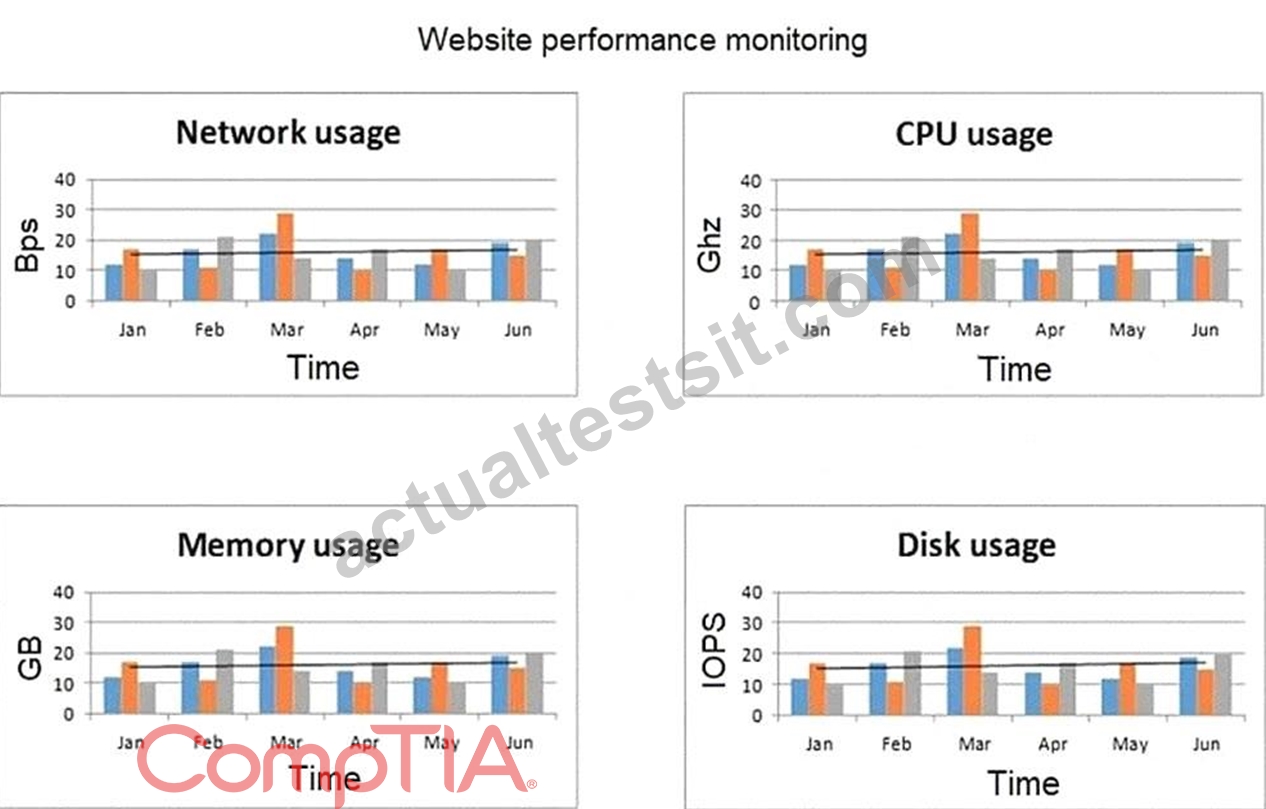
Which of the following is the most useful information to add to the dashboard for the operations team?
- A. Number of orders
- B. Number of active incidents
- C. Concurrent users
- D. 404 errors
Answer: C
Explanation:
Comprehensive and Detailed Explanation From Exact Extract:
While resource usage metrics (CPU, memory, disk, network) are important, the missing context here is user demand. Adding "Concurrent users" helps correlate resource utilization spikes with actual user load. For performance monitoring in web applications, concurrent sessions provide crucial insight into whether performance issues are demand-related.
Relevant Extract from CompTIA CloudNetX CNX-001 Study Guide - under "Performance Monitoring and User Metrics":
"Monitoring user load metrics such as concurrent users provides insight into performance degradation and capacity planning. These are critical for identifying thresholds and auto-scaling requirements." Other options:
* A. 404 errors indicate broken links but don't explain performance issues.
* C. Number of orders tracks business activity, not system strain.
* D. Active incidents belong in an ITSM system, not real-time performance monitoring.
NEW QUESTION # 18
A network architect needs to build a new data center for a large company that has business units that process retail financial transactions. Which of the following information should the architect request from the company?
- A. Internal reference architecture
- B. Regulatory requirements
- C. Statement of work
- D. Business case study
Answer: B
Explanation:
Before designing a facility that will handle retail financial transactions, you need to understand all applicable compliance and security mandates (e.g. PCI DSS, SOX, GDPR). Those regulatory requirements will drive your choices around physical security, network segmentation, encryption, logging, redundancy, and operational controls, ensuring the data center meets its legal and industry-specific obligations.
NEW QUESTION # 19
A global company has depots in various locations. A proprietary application was deployed locally at each of the depots, but issues with getting the consolidated data instantly occurred. The Chief Information Officer decided to centralize the application and deploy it in the cloud. After the cloud deployment, users report the application is slow. Which of the following is most likely the issue?
- A. Packet loss
- B. Throttling
- C. Latency
- D. Overutilization
Answer: C
Explanation:
Centralizing the application in the cloud introduces longer round-trip times for geographically dispersed users.
The increased propagation delay ("latency") is the most likely cause of the perceived slowness.
NEW QUESTION # 20
An architect needs to deploy a new payroll application on a cloud host. End users' access to the application will be based on the end users' role. In addition, the host must be deployed on the 192.168.77.32/30 subnet.
Which of the following Zero Trust elements are being implemented in this design? (Choose two.)
- A. Device trust
- B. WAF
- C. Microsegmentation
- D. Least privilege
- E. CASB
- F. MFA
Answer: C,D
Explanation:
Comprehensive and Detailed Explanation From Exact Extract:
A: Least privilege - This Zero Trust principle ensures users can only access the resources necessary for their job roles. Role-based access control (RBAC), as mentioned in the scenario, is a textbook implementation of least privilege.
C: Microsegmentation - Deploying the application in a small subnet (192.168.77.32/30 provides only 2 usable host IPs) limits lateral movement and isolates the host at a network level. This is a key characteristic of microsegmentation, where resources are placed in small, tightly controlled network segments.
Relevant Extract from CompTIA CloudNetX CNX-001 Study Guide - under "Zero Trust Security Architecture":
"Least privilege enforces access permissions based on job responsibilities."
"Microsegmentation applies granular isolation policies between resources to reduce the attack surface and lateral movement." Other options:
* B. Device trust involves assessing device posture and compliance before granting access.
* D. CASB (Cloud Access Security Broker) governs cloud access, not access control or subnetting.
* E. WAF protects web applications but is not a Zero Trust element directly related to access control.
* F. MFA supports identity verification but is not directly evidenced in the scenario.
NEW QUESTION # 21
A company is experiencing Wi-Fi performance issues. Three Wi-Fi networks are available, each running on the 2.4 GHz band and on the same channel. Connecting to each Wi-Fi network yields slow performance.
Which of the following channels should the networks be configured to?
- A. Channel 1, Channel 2. and Channel 3
- B. Channel 1, Channel 6, and Channel 11
- C. Channel 2. Channel 4, and Channel 9
- D. Channel 3, Channel 5, and Channel 10
Answer: B
Explanation:
These are the three non-overlapping channels in the 2.4 GHz band, eliminating co-channel and adjacent- channel interference for optimal Wi-Fi performance.
NEW QUESTION # 22
A network security engineer must secure a web application running on virtual machines in a public cloud. The virtual machines are behind an application load balancer. Which of the following technologies should the engineer use to secure the virtual machines? (Choose two.)
- A. DLP
- B. IDS
- C. CDN
- D. SIEM
- E. WAF
- F. NSG
Answer: E,F
Explanation:
WAF: Protects the web application by inspecting incoming HTTP/HTTPS requests at the load balancer, blocking SQL injection, XSS, and other common web attacks.
NSG: Enforces network-layer controls on the VMs' subnets or interfaces, allowing only approved ports and IP ranges to reach the application servers.
NEW QUESTION # 23
A company hosts its application s on the cloud and is expanding its business to Europe. The company must comply with General Data Protection Regulation to limit European customers' access to data. The network team configures the firewall rules but finds that some customers in the United States can access data hosted in Europe. Which of the following is the best option for the network team to configure?
- A. SASE
- B. Geofencing rule
- C. CDN
- D. Network security groups
Answer: B
Explanation:
Using a geofencing (geo#restriction) policy lets you block or allow traffic based on the client's geographic location. This ensures that only users in approved regions (e.g., the United States) can reach the European- hosted data, effectively preventing unintended European customer access without complex IP ACLs.
NEW QUESTION # 24
A network architect needs to design a new network to connect multiple private data centers. The network must:
Provide privacy for all traffic between locations.
Use preexisting internet connections.
Use intelligent steering of application traffic over the best path.
Which of the following best meets these requirements?
- A. ExpressRoute
- B. Site-to-site VPN
- C. SD-WAN
- D. MPLS connections
Answer: C
Explanation:
By running encrypted tunnels over your existing Internet links and dynamically steering traffic across the optimal path, an SD-WAN solution delivers privacy and performance intelligence without requiring new private circuits.
NEW QUESTION # 25
A cloud architect must recommend an architecture approach for a new medical application that requires the lowest downtime possible. Which of the following is the best application deployment strategy given the high- availability requirement?
- A. Four different availability zones using an active-passive topology in a single region
- B. Two different availability zones (per region) using an active-active topology in two different regions
- C. Four different availability zones using an active-active topology in a single region
- D. Two different availability zones (per region) using an active-passive topology in two different regions
Answer: B
Explanation:
Deploying active-active clusters across two AZs in each of two regions ensures the application can survive both AZ- and entire-region failures, delivering the highest possible uptime.
NEW QUESTION # 26
A company is experiencing numerous network issues and decides to expand its support team. The new junior employees will need to be onboarded in the shortest time possible and be able to troubleshoot issues with minimal assistance. Which of the following should the company create to achieve this goal?
- A. Physical and logical network diagrams of the entire networking infrastructure
- B. Clearly documented runbooks for networking issues and knowledge base articles
- C. Statement of work documenting what each junior employee should do when troubleshooting
- D. A mentor program for guiding each junior employee until they are familiar with the networking infrastructure
Answer: B
Explanation:
Comprehensive and Detailed Explanation From Exact Extract:
Runbooks and knowledge base articles provide step-by-step instructions for resolving common issues, helping new employees quickly become productive with minimal supervision. These documents can be updated as new issues arise and serve as a foundational training and operational resource.
Relevant Extract from CompTIA CloudNetX CNX-001 Study Guide - under "Operational Documentation and Knowledge Transfer":
"Runbooks contain standardized procedures for handling recurring operational tasks. Knowledge base articles enable consistent troubleshooting and resolution with minimal oversight." Other options:
* A. A Statement of Work (SOW) is used for defining project deliverables, not training.
* C. Network diagrams are useful for understanding architecture, but not for operational procedures.
* D. A mentor program can help, but it doesn't scale or provide immediate troubleshooting steps.
NEW QUESTION # 27
A user reports an issue connecting to a database server. The front-end application for this database is hosted on the company's web server. The network engineer has changed the network subnet that the company servers are located on along with the IP addresses of the servers. These are the new configurations:
* New subnet for the servers is 10.10.10.64/27
* Web server IP address is 10.10.10.101
* Database server IP is 10.10.10.93
Which of the following is most likely causing the user's issue?
- A. The database server firewall is blocking the port to the database.
- B. The DNS server is not resolving properly.
- C. The web application server is not forwarding the requests.
- D. The web server does not have the correct network configuration.
Answer: B
Explanation:
Comprehensive and Detailed Explanation From Exact Extract:
Since the subnet and IPs were changed recently, and users are accessing the database through a web application, the likely issue is that DNS records have not been updated to reflect the new IP addresses. If DNS is pointing to old IPs, users will fail to reach the services even if they are up and reachable on the new subnet.
Relevant Extract from CompTIA CloudNetX CNX-001 Study Guide - under "DNS and Network Configuration Troubleshooting":
"DNS misconfiguration is a common issue following IP address changes. If DNS entries are not updated accordingly, clients will attempt to reach services at outdated IPs." Other options:
* A. No indication of web server misconfiguration is provided.
* B. Firewall issues would affect all users, not just one.
* D. The web server has a valid IP in the subnet range; no misconfiguration is indicated.
NEW QUESTION # 28
......
CompTIA CNX-001 Exam Syllabus Topics:
| Topic | Details |
|---|---|
| Topic 1 |
|
| Topic 2 |
|
| Topic 3 |
|
| Topic 4 |
|
CNX-001 Actual Questions Answers PDF 100% Cover Real Exam Questions: https://protechtraining.actualtestsit.com/CompTIA/CNX-001-exam-prep-dumps.html