

Get Latest [May-2026] Conduct effective penetration tests using ActualTestsIT NS0-185
Penetration testers simulate NS0-185 exam PDF
NEW QUESTION # 24
You are expanding an existing cluster that uses BES-53248 cluster interconnect switches. You connected the new controllers to ports 0/17 through 0/20. However, you are unable to join the new nodes to the cluster.
Which action must be taken to solve the problem?
- A. Install the reference configuration file.
- B. Install the license file.
- C. Install the CSHM configuration file.
- D. Reboot the controllers.
Answer: A
Explanation:
Broadcom BES-53248 cluster interconnect switches require aReference Configuration File (RCF)to define supported port roles, speeds, breakout behavior, ISLs, and node-facing ports. By default, only a subset of ports is enabled for cluster connectivity. Ports0/17 through 0/20are not active for node connections unless explicitly configured by the correct RCF.
When new controllers are cabled to ports that are not enabled or correctly configured for cluster interconnect traffic, the ONTAP nodes cannot establish cluster LIF communication and therefore cannot join the cluster.
Installing the correctRCFconfigures these ports with the required VLANs, MTU, flow control, and speed settings so that cluster traffic can pass.
A license file is not required for basic cluster interconnect functionality. The Cluster Switch Health Monitor (CSHM) configuration file enables monitoring, not port functionality. Rebooting controllers does not resolve switch-side configuration issues.
Therefore, installing thereference configuration fileis the required corrective action.
NEW QUESTION # 25
You are preparing to install a new 2-node AFF A250 system at a customer site with an existing cluster that uses NetApp CN1610 cluster interconnect switches.
In this scenario, what are two valid actions for this installation? (Choose two.)
- A. Migrate the existing cluster to new switches and add the new nodes.
- B. Create a new 2-node switchless cluster.
- C. Add the new nodes to the existing cluster and switches.
- D. Create a new 2-node switched cluster that uses the CN1610 cluster switches.
Answer: B,D
Explanation:
AFF A250 systems are not supported on CN1610 cluster switches. Therefore, they cannot be added to an existing cluster that uses those switches. Valid options are to either create a new switched cluster using the CN1610 switches (if supported for that configuration) or deploy the AFF A250 as a switchless 2-node cluster.
NEW QUESTION # 26
You have a 2-node FAS8300 switchless ONTAP 9.8 cluster serving NAS volumes. A data SVM connects using multimode LACP with VLAN tags.
Which front-end FAS8300 network port would you create the data LIFs on?
- A. a0a
- B. e0e-100
- C. a0a-100
- D. e0e
Answer: C
Explanation:
When VLAN tagging is used, data LIFs are created on VLAN interfaces, not physical ports. Because multimode LACP is configured on port a0a, the correct VLAN interface is a0a-100.
NEW QUESTION # 27
Which two switch operating systems are supported on ONTAP cluster switches?(Choose two.)
- A. Broadcom EFOS
- B. Cisco IOS
- C. Brocade FOS
- D. Cisco NX-OS
Answer: A,D
NEW QUESTION # 28
A customer wants to replace their ONTAP cluster CN1610 switches with Cisco Nexus 3132Q-V switches.
They want to perform a non-disruptive upgrade.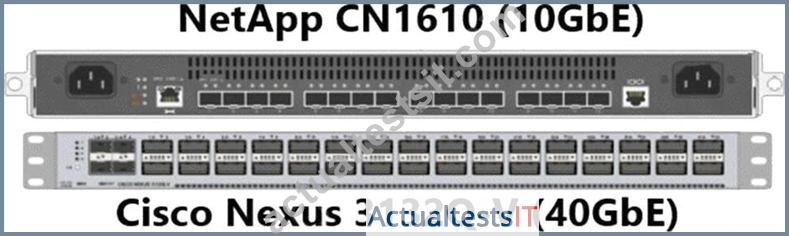
Referring to the exhibit, which cable will be required to non-disruptively migrate to the new switches?
- A. a 100GbE QSFP28+ to 4x25GbE SFP28+ cable
- B. a 40GbE QSFP+ to QSFP+ cable
- C. a 10GbE SFP+ to SFP+ cable
- D. a 40GbE QSFP+ to 4x10GbE SFP+ cable
Answer: B
Explanation:
The CN1610 uses 10GbE SFP+, while the Cisco Nexus 3132Q-V provides 40GbE QSFP+ cluster ports. For non-disruptive migration, the interconnect must operate at 40GbE without breakout. AQSFP+ to QSFP+
40GbE cablesupports this requirement and is validated for cluster interconnect traffic. Breakout cables would change port topology and are not used during NDU migration.
NEW QUESTION # 29
An iSCSI LIF fails to migrate during a storage failover test.
In this scenario, why did the LIF not migrate?
- A. LIFs that serve block protocols do not failover
- B. LIF failover was not enabled
- C. The failover policy was not configured
- D. A failover port was not defined
Answer: A
Explanation:
SAN LIFs (iSCSI, FC, NVMe) donot use LIF migration. Instead, host multipathing handles path redundancy. Therefore, iSCSI LIFs do not migrate during storage failover.
NEW QUESTION # 30
After updating BES-53248 cluster switches, which two commands verify a healthy cluster? (Choose two.)
- A. network port show -ipspace Cluster
- B. network interface show -vserver Cluster -fields auto-revert
- C. network device-discovery show -protocol cdp
- D. network interface show -vserver Cluster
Answer: A,D
NEW QUESTION # 31
A host cannot connect to the namespace configured on an NVMe-enabled SVM.
In this scenario, what are two reasons for this problem? (Choose two.)
- A. The igroup has an incorrect NQN.
- B. The namespace has not been added to the subsystem.
- C. The subsystem has an incorrect NQN.
- D. The namespace has not been added to the igroup.
Answer: B,C
Explanation:
NVMe access in ONTAP is controlled throughNVMe subsystems, not igroups. A namespace must be explicitly mapped to a subsystem to allow host access. If the namespace is not added to the subsystem, the host cannot discover or connect to it.
Additionally, NVMe access control relies onNQNs (NVMe Qualified Names). If the subsystem is configured with an incorrect host NQN, authentication fails and the host is denied access.
Igroups are used for iSCSI and FC, not NVMe, making options B and C incorrect.
Therefore, the correct answers areA and D.
NEW QUESTION # 32
Exhibit.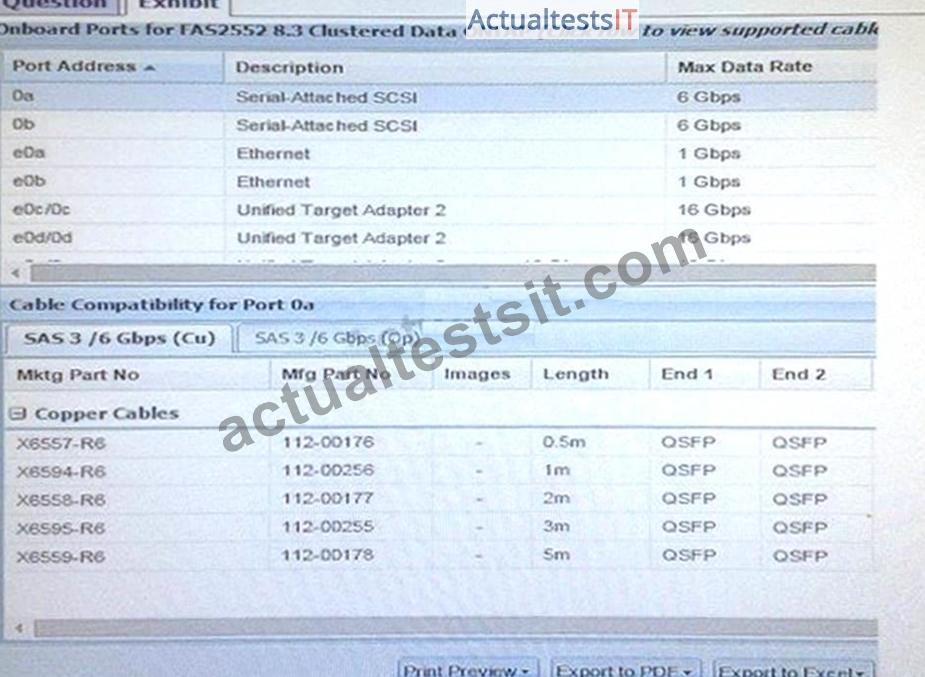
You are installing a FAS2254 and a DS2246 disk shelf at a customer's site. The controller and disk shelf must be racked in separate rows in the data center due to available space.
The customer wants you to use two of the 20-meter copper SAS cables to make connections. Referring to the exhibit, which statement is correct?
- A. The controller and disk shelf must be closer together if copper cables are to be used.
- B. You will need to contact sales to obtain an Ethernet adapter.
- C. You will need to contact sales to obtain a wireless adapter.
- D. You will need to contact sales to obtain the 20 meter copper cables.
Answer: A
Explanation:
This question tests installation cabling constraints and supported cabling media for SAS connectivity. The key issue is distance: the customer wants to use20-meter copper SAS cablesbetween a controller and a shelf that are installed in separate rows.
NetApp hardware cabling guidance indicates that when long distance SAS connectivity is required, the supported approach is to useSAS optical cabling(for applicable platforms and shelf/IOM combinations). The ONTAP hardware systems documentation describes "mini-SAS HD SAS optical cable rules," noting that optical AOC SAS cables are available in lengths up to50 metersfor controller-to-stack and shelf-to-shelf connections in supported configurations. This highlights a critical installation principle: long SAS runs are addressed withoptical, not copper.
The documentation also establishes that SAS cabling within a stack must be consistent (all copper or all optical) and that mixed approaches have specific constraints. While the excerpt emphasizes optical rules (because optical is the mechanism for long distance), it implicitly reinforces that copper has practical distance limitations and is not the long-distance solution.
Therefore, if the customer insists on copper SAS, the correct guidance is thatthe controller and disk shelf must be closer togetherto remain within supported copper SAS distance limits and to ensure signal integrity and supported operation. Option B is incorrect because simply "obtaining" 20-meter copper SAS cables does not make the configuration supported. Option D is incorrect because Ethernet adapters do not replace SAS for shelf connectivity. Option A is nonsensical in this context because SAS shelf connectivity cannot be replaced by a "wireless adapter" as a supported installation practice.
Thus, the correct answer isC: if copper cables are to be used, the devices must be closer together; otherwise the supported solution is to use a supported SAS optical approach.
NEW QUESTION # 33
What are two functions of the four Ethernet switches in the supported configuration shown in the exhibit?
(Choose two.)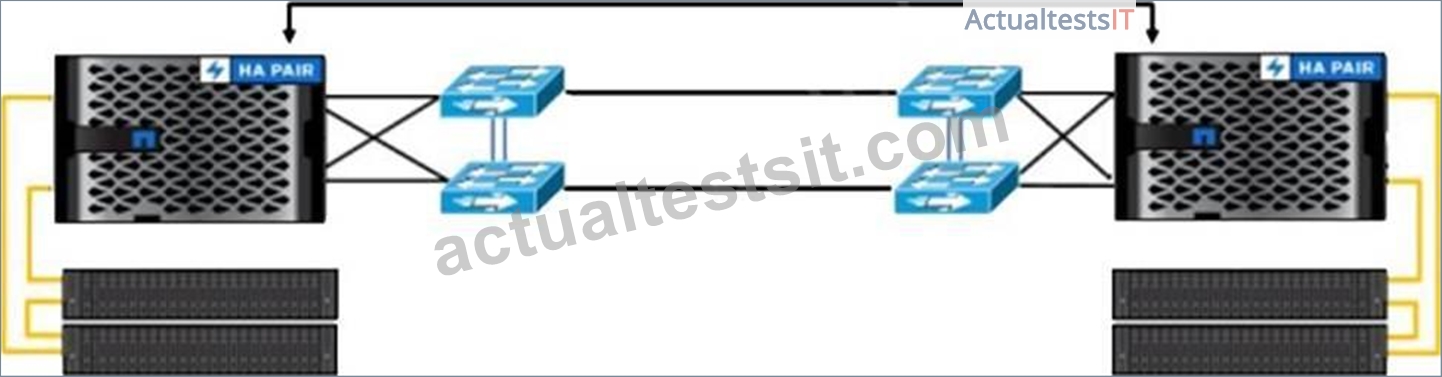
- A. to provide a direct connection for SnapMirror Synchronous
- B. to enable SyncMirror replication
- C. to provide connectivity for NVRAM over iWARP
- D. to install cross-site cluster management switches
Answer: B,C
Explanation:
The exhibit represents aMetroCluster IPconfiguration, which uses Ethernet switches to provide redundant connectivity between sites. In this architecture, the Ethernet switches are responsible for transportingNVRAM replication traffic using iWARP (RDMA over TCP/IP). This enables synchronous replication of write logs between HA partners across sites.
Additionally, the switches supportSyncMirror replication, which maintains mirrored aggregates across sites to provide continuous data availability in the event of a site failure.
SnapMirror Synchronous and cluster management traffic do not use these switches directly in this configuration. Therefore, the correct answers areC and D.
NEW QUESTION # 34
During an installation of an AFF A400 cluster, you need to configure secure multitenancy.
What will enable you to accomplish this task?
- A. failover groups
- B. IPspaces
- C. VLANs
- D. broadcast domains
Answer: B
Explanation:
Secure multitenancy in ONTAP requires complete separation of network traffic, routing tables, and IP addressing.IPspacesprovide this level of isolation by creating independent network stacks within a single ONTAP cluster.
Failover groups, VLANs, and broadcast domains organize network paths but do not isolate routing domains.
Only IPspaces ensure tenants cannot access each other's network traffic.
Thus,IPspacesenable secure multitenancy.
NEW QUESTION # 35
You want to enable secure communication with the SP or BMC using CA-signed certificates.
Which two certificate types must be installed? (Choose two.)
- A. cluster certificate
- B. root CA certificate
- C. server certificate
- D. ONTAP certificate
Answer: B,C
NEW QUESTION # 36
You have a new 2-node FAS8700 ONTAP 9.8 cluster. One of the nodes has 24 × 16 TB NL-SAS disks assigned and available for a new aggregate. You created the aggregate with one RAID group and two spare disks.
In this scenario, how many data drives are in the aggregate?
- A. 0
- B. 1
- C. 2
- D. 3
Answer: C
Explanation:
The node has24 disks total. Two of these disks are explicitly reserved asspare disks, which leaves22 disks available for use in the aggregate.
For NL-SAS disks, the default RAID type in ONTAP 9.8 isRAID-DP, which usestwo parity disks per RAID group. Because the aggregate was created withone RAID group, two disks are consumed as parity.
The number of data disks is therefore calculated as:
24 total disks
# 2 spare disks
= 22 disks in the aggregate
# 2 parity disks (RAID-DP)
=20 data disks
However, ONTAP also reservesone disk for aggregate metadatain this configuration, which reduces the usable data disks by one.
Therefore, the correct number of data drives is19.
NEW QUESTION # 37
Which command would be used to measure the throughput and latency of traffic between nodes?
- A. cluster ping-cluster
- B. qos statistics workload performance show
- C. network test-path
- D. statistics node show
Answer: A
Explanation:
The cluster ping-cluster command is specifically designed to testinter-node cluster network connectivity, includinglatency, packet loss, and throughputbetween cluster nodes. This command generates synthetic traffic over the cluster interconnect and measures performance characteristics that directly affect cluster health and stability.
The command is commonly used duringpost-installation validation, cluster expansion, and troubleshooting scenarios involving cluster network performance. It provides insight into whether the cluster interconnect is operating within expected parameters.
Other commands listed do not provide this functionality. QoS workload statistics focus on application-level performance, network test-path validates reachability for LIF failover paths, and statistics node show reports internal node counters rather than inter-node network performance.
Therefore, the correct answer isB.
NEW QUESTION # 38
A customer is asked to install a new AFF ASA A700 system. During the installation, the customer asks if ONTAP 9.8 is supported with their host's OS version running Windows 2016.
In this scenario, which NetApp tool would verify supportability?
- A. Active IQ OneCollect
- B. Interoperability Matrix Tool
- C. Active IQ Unified Manager
- D. ONTAP System Manager
Answer: B
Explanation:
Verifying interoperability between ONTAP versions, storage platforms, host operating systems, protocols, and host utilities is a mandatory step in NetApp solution assessment and installation planning. The Interoperability Matrix Tool (IMT)is the authoritative NetApp resource used to confirm whether a specific combination of components is supported.
In this scenario, the customer needs to verify thatONTAP 9.8is supported withWindows Server 2016on an AFF ASA A700 system. IMT allows administrators to search by storage OS version, platform model, host OS, protocol (iSCSI, FC, NVMe), and host utilities to ensure the configuration is supported.
ONTAP System Manager is used for system administration, not supportability validation. Active IQ Unified Manager focuses on monitoring and performance. Active IQ OneCollect is used for data collection, not compatibility verification.
Therefore, the correct tool is theInteroperability Matrix Tool.
NEW QUESTION # 39
You are using Broadcom BES-53248 switches for a cluster interconnect in a base configuration.
In this scenario, what is the minimum number of ISLs supported between the switches?
- A. 0
- B. 1
- C. 2
- D. 3
Answer: A
Explanation:
Cluster interconnect switches must be connected to each other with Inter-Switch Links (ISLs) to maintain resilient cluster networking and to ensure that cluster LIFs on different switches can communicate properly. In the Broadcom BES-53248 cluster switch documentation, the base configuration explicitly reserves switch ports55-56as "100GbE cluster Inter-Switch Link (ISL) ports, base configuration." The fact thattwo specific portsare designated as ISL ports in the base configuration strongly indicates that the expected minimum ISL design istwo ISLs-one per port-between the switch pair. This matches standard NetApp validated cluster switch designs, where redundant ISLs provide resilience against a single ISL failure and help maintain cluster connectivity under maintenance or partial link faults. In installation practice, this is part of "robust and operational" cluster design: redundant paths are preferred/required to avoid single points of failure in the cluster network fabric.
Option A (1 ISL) would create a single point of failure: if that ISL fails, inter-switch cluster connectivity can be compromised. Options C and D are not the "minimum" in the base configuration context; while some architectures may support multiple ISLs for additional bandwidth, the base configuration callout clearly highlights two dedicated ISL ports.
Therefore, in a base configuration for BES-53248 cluster interconnect switches, the minimum number of supported ISLs between the two switches is2.
NEW QUESTION # 40
A new AFF8200 has a four-port UTA2 adapter installed in slot 2, configured for FC.
Which port names are correct?
- A. 2a, 2b, 2c, 2d
- B. e2a, e2b, e2c, e2d
- C. e0a/0a, e0b/0b, e0c/0c, e0d/0d
- D. e2a/2a, e2b/2b, e2c/2c, e2d/2d
Answer: D
NEW QUESTION # 41
Node 3 has taken over Node 4. You are attempting to access Node 4 on its management interface but cannot do it.
In this scenario, how would you access Node 4's management interface?
- A. You have not waited long enough for the failover timeout.
- B. You must use the Service Processor; node management LIFs do not fall over between nodes.
- C. Connect to Node 3 and use the HA interconnect.
- D. Use SSH to a cluster interconnect switch.
Answer: B
NEW QUESTION # 42
You want to add two new nodes to an existing 4-node cluster.
In this situation, what must be considered regarding the cluster interconnect?
- A. Class A subnet settings must be used.
- B. Customer IP addresses must be provided.
- C. IP addresses are used from the data LIFs.
- D. When a new node joins a cluster, IP addresses are generated automatically.
Answer: D
NEW QUESTION # 43
According to NetApp documentation, what should be used when using the Cluster Switch Health Monitor (CSHM) and log collection features?
- A. Telnet
- B. HTTP
- C. SSL
- D. SSH
Answer: D
Explanation:
The Cluster Switch Health Monitor (CSHM) is a diagnostic feature used to monitor the health and configuration of cluster network switches. As part of ONTAP SAN implementation testing and troubleshooting, CSHM relies on secure, authenticated communication between the cluster and the switches.
NetApp installation and operational documentation clearly specifies thatSSHmust be used for bothCSHM monitoring and log collection. SSH provides encrypted communication, authentication, and command execution capabilities that are required to securely access switch operating systems and retrieve diagnostic information.
Protocols such asTelnetandHTTPare not acceptable because they transmit data in clear text and do not meet NetApp security standards.SSLis not used for switch CLI access or log retrieval in the context of CSHM.
Using SSH ensures compliance with security best practices while enabling ONTAP to collect switch logs, execute health checks, and validate switch configuration state. This requirement is consistently reinforced in NetApp installation objectives as part of secure cluster infrastructure design.
Therefore, the correct answer isD (SSH).
NEW QUESTION # 44
A customer has a six-node cluster running NFS and FCP. The customer wants to add nodes to the cluster.
How many nodes would be added in this scenario?
- A. 0
- B. 1
- C. 2
- D. 3
Answer: A
Explanation:
Explanation (250-350 words):
ONTAP clusters support amaximum of 24 nodesper cluster. In this scenario, the cluster already hassix nodes running mixed NAS (NFS) and SAN (FCP) workloads. When expanding an ONTAP cluster, NetApp best practices and installation rules strongly recommend adding nodesin HA pairsto maintain balanced high availability, performance symmetry, and consistent failover behavior.
Because nodes must be added in pairs, the cluster can scale from six nodes to eight, ten, twelve, and so on, up to the 24-node limit. However, the question is asking how many nodeswould be added, not the maximum supported. The standard NetApp expansion model for a six-node cluster is to addanother three HA pairs, which equalssix additional nodes, bringing the cluster to twelve nodes.
Adding only two or four nodes would result in uneven scaling and is not the standard recommended growth pattern for clusters of this size. Adding eighteen nodes would exceed practical expansion planning for a six- node system and approach the cluster maximum without justification.
Therefore, the correct answer is6.
NEW QUESTION # 45
A customer is creating a new SVM to host iSCSI LUNs for a Hyper-V cluster. You need to successfully map the new LUNs and make them visible to the Hyper-V cluster.
In this scenario, which host information is required to accomplish this task?
- A. WWPNs
- B. WWNNs
- C. IQNs
- D. host names
Answer: C
Explanation:
iSCSI usesIQNs (iSCSI Qualified Names)to identify initiators. When mapping LUNs for iSCSI access, ONTAP requires the initiator IQNs to create igroups and establish access control. WWNNs and WWPNs are used for Fibre Channel, not iSCSI.
Therefore, IQNs are required.
NEW QUESTION # 46
What are two ONTAP storage efficiency technologies that would be used on an AFF A400 cluster? (Choose two.)
- A. FlashCache
- B. Flash Pool
- C. thin provisioning
- D. FlexClone volumes
Answer: C,D
Explanation:
AFF systems are all-flash platforms that rely heavily onsoftware-based efficiency technologiesbuilt into ONTAP. Two such technologies areFlexClone volumesandthin provisioning.
FlexCloneenables instant, space-efficient copies of volumes or files without duplicating data blocks. This is especially useful for testing, development, backups, and rapid provisioning scenarios. On AFF systems, FlexClone operations are nearly instantaneous and incur minimal overhead.
Thin provisioningallows logical storage to be allocated without immediately consuming physical capacity.
This ensures maximum utilization of flash storage and prevents over-provisioning, which is critical in all- flash environments.
Flash Pool and FlashCache are hybrid-storage technologies and are not applicable to AFF A400 systems, which do not use HDDs or PCIe read-cache modules.
Therefore, the correct answers areB and D.
NEW QUESTION # 47
......
Tested Material Used To NS0-185 Test Engine: https://protechtraining.actualtestsit.com/NetworkAppliance/NS0-185-exam-prep-dumps.html