

Grab latest Google Professional-Cloud-Developer Dumps as PDF Updated on 2023
Newly Released Professional-Cloud-Developer Dumps for Cloud Developer Certified
Google Professional-Cloud-Developer (Google Certified Professional - Cloud Developer) Certification Exam is designed to validate the skills and knowledge of cloud developers who specialize in Google Cloud Platform (GCP) technologies. Google Certified Professional - Cloud Developer certification is intended for individuals who are involved in developing, deploying, and managing applications and services on the GCP. Professional-Cloud-Developer exam measures various aspects of cloud development, such as designing, building, testing, and deploying cloud-native applications on the GCP.
Google Professional-Cloud-Developer certification exam is a challenging and rewarding way for developers to demonstrate their expertise in developing applications on the Google Cloud Platform. By passing the exam, developers can prove their skills and knowledge to employers and clients, open up new job opportunities, and increase their earning potential.
Google Professional-Cloud-Developer certification is recognized globally and is highly valued in the cloud computing industry. Google Certified Professional - Cloud Developer certification provides a competitive edge to software developers and helps them to stand out in the job market. In addition, this certification also helps organizations to identify and hire skilled professionals who can develop and deploy applications on GCP. By becoming a Google Certified Professional - Cloud Developer, individuals can demonstrate their commitment to staying current with the latest cloud technologies and their ability to design, develop, and manage cloud applications on GCP.
NEW QUESTION # 80
You suspect that the issue Darla describes is a result of how she is using her iPhone. Which of the following is an empathetic and supportive closed question to ask?
- A. Why didn't you review the iPhone User Guide before you tried to use your phone?
- B. Do you mind if I show you a couple of ways I learned to use the iPhone?
- C. That is not the correct way of using the iPhone; do you need a demonstration?
- D. Do you realize how you are using the iPhone is causing your issue?
Answer: B
Explanation:
Explanation
NEW QUESTION # 81
You want to view the memory usage of your application deployed on Compute Engine. What should you do?
- A. Install the Stackdriver Monitoring Agent.
- B. Use the Google Cloud Platform Console.
- C. Install the Stackdriver Client Library.
- D. Use the Stackdriver Metrics Explorer.
Answer: D
NEW QUESTION # 82
Your existing application keeps user state information in a single MySQL database. This state information is very user-specific and depends heavily on how long a user has been using an application. The MySQL database is causing challenges to maintain and enhance the schema for various users.
Which storage option should you choose?
- A. Cloud Datastore/Firestore
- B. Cloud Spanner
- C. Cloud Storage
- D. Cloud SQL
Answer: D
NEW QUESTION # 83
You need to redesign the ingestion of audit events from your authentication service to allow it to handle a large increase in traffic. Currently, the audit service and the authentication system run in the same Compute Engine virtual machine. You plan to use the following Google Cloud tools in the new architecture:
Multiple Compute Engine machines, each running an instance of the authentication service Multiple Compute Engine machines, each running an instance of the audit service Pub/Sub to send the events from the authentication services.
How should you set up the topics and subscriptions to ensure that the system can handle a large volume of messages and can scale efficiently?
- A. Create one Pub/Sub topic. Create one pull subscription per audit service instance to allow the services to share the messages.
- B. Create one Pub/Sub topic per authentication service. Create one push subscription per topic, with the endpoint pointing to one audit service.
- C. Create one Pub/Sub topic. Create one pull subscription to allow the audit services to share the messages.
- D. Create one Pub/Sub topic per authentication service. Create one pull subscription per topic to be used by one audit service.
- E. Create one Pub/Sub topic. Create one push subscription with the endpoint pointing to a load balancer in front of the audit services.
Answer: C
Explanation:
Explanation
https://cloud.google.com/pubsub/docs/subscriber "Multiple subscribers can make pull calls to the same "shared" subscription. Each subscriber will receive a subset of the messages."
NEW QUESTION # 84
Your teammate has asked you to review the code below. Its purpose is to efficiently add a large number of small rows to a BigQuery table.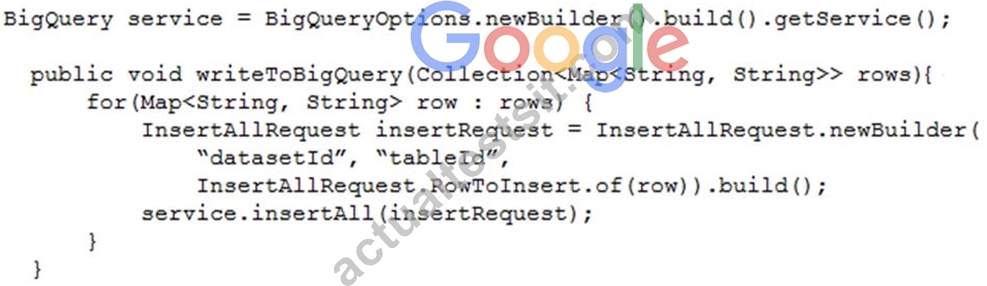
Which improvement should you suggest your teammate make?
- A. Write each row to a Cloud Storage object in parallel, then load into BigQuery.
- B. Write each row to a Cloud Storage object, then load into BigQuery.
- C. Perform the inserts in parallel by creating multiple threads.
- D. Include multiple rows with each request.
Answer: C
NEW QUESTION # 85
Your company has created an application that uploads a report to a Cloud Storage bucket. When the report is uploaded to the bucket, you want to publish a message to a Cloud Pub/Sub topic. You want to implement a solution that will take a small amount to effort to implement. What should you do?
- A. Configure the Cloud Storage bucket to trigger Cloud Pub/Sub notifications when objects are modified.
- B. Create an App Engine application to receive the file; when it is received, publish a message to the Cloud Pub/Sub topic.
- C. Create an application deployed in a Google Kubernetes Engine cluster to receive the file; when it is received, publish a message to the Cloud Pub/Sub topic.
- D. Create a Cloud Function that is triggered by the Cloud Storage bucket. In the Cloud Function, publish a message to the Cloud Pub/Sub topic.
Answer: D
Explanation:
Explanation
https://cloud.google.com/storage/docs/pubsub-notifications
NEW QUESTION # 86
You work for a web development team at a small startup. Your team is developing a Node.js application using Google Cloud services, including Cloud Storage and Cloud Build. The team uses a Git repository for version control. Your manager calls you over the weekend and instructs you to make an emergency update to one of the company's websites, and you're the only developer available. You need to access Google Cloud to make the update, but you don't have your work laptop. You are not allowed to store source code locally on a non-corporate computer. How should you set up your developer environment?
- A. Use Cloud Shell and the built-in code editor for development. Send your source code updates as pull requests.
- B. Use a text editor and the Git command line to send your source code updates as pull requests from a virtual machine running on a public computer.
- C. Use a Cloud Storage bucket to store the source code that you need to edit. Mount the bucket to a public computer as a drive, and use a code editor to update the code. Turn on versioning for the bucket, and point it to the team's Git repository.
- D. Use a text editor and the Git command line to send your source code updates as pull requests from a public computer.
Answer: A
Explanation:
https://cloud.google.com/shell/docs
NEW QUESTION # 87
You are developing a new application that has the following design requirements:
Creation and changes to the application infrastructure are versioned and auditable.
The application and deployment infrastructure uses Google-managed services as much as possible.
The application runs on a serverless compute platform.
How should you design the application's architecture?
- A. 1. Deploy Jenkins from the Google Cloud Marketplace, and define a continuous integration pipeline in Jenkins.
2. Configure a pipeline step to pull the application source code from a Git repository.
3. Deploy the application source code to App Engine as a pipeline step. - B. 1. Store the application and infrastructure source code in a Git repository.
2. Use Cloud Build to deploy the application infrastructure with Terraform.
3. Deploy the application to a Cloud Function as a pipeline step. - C. 1. Create a continuous integration pipeline on Cloud Build, and configure the pipeline to deploy the application infrastructure using Deployment Manager templates.
2. Configure a pipeline step to create a container with the latest application source code.
3. Deploy the container to a Compute Engine instance as a pipeline step. - D. 1. Deploy the application infrastructure using gcloud commands.
2. Use Cloud Build to define a continuous integration pipeline for changes to the application source code.
3. Configure a pipeline step to pull the application source code from a Git repository, and create a containerized application.
4. Deploy the new container on Cloud Run as a pipeline step.
Answer: D
Explanation:
Reference: https://cloud.google.com/docs/ci-cd
NEW QUESTION # 88
Your teammate has asked you to review the code below, which is adding a credit to an account balance in Cloud Datastore. Which improvement should you suggest your teammate make?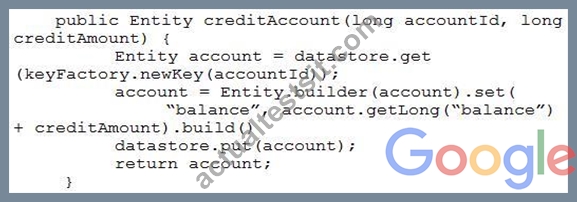
- A. Get the entity with an ancestor query.
- B. Don't return the account entity from the function.
- C. Get and put the entity in a transaction.
- D. Use a strongly consistent transactional database.
Answer: A
NEW QUESTION # 89
Your company's development teams want to use various open source operating systems in their Docker builds.
When images are created in published containers in your company's environment, you need to scan them for Common Vulnerabilities and Exposures (CVEs). The scanning process must not impact software development agility. You want to use managed services where possible. What should you do?
- A. Use Cloud Monitoring to review the output of Cloud Build to determine whether a vulnerable version has been used.
- B. Create a Cloud Function that is triggered on a code check-in and scan the code for CVEs.
- C. Disallow the use of non-commercially supported base images in your development environment.
- D. Enable the Vulnerability scanning setting in the Container Registry.
Answer: D
Explanation:
Explanation
https://cloud.google.com/container-analysis/docs/os-overview
NEW QUESTION # 90
You are working on a social media application. You plan to add a feature that allows users to upload images.
These images will be 2 MB - 1 GB in size. You want to minimize their infrastructure operations overhead for this feature. What should you do?
- A. Change the application to create signed URLs for Cloud Storage. Transfer these signed URLs to the client application to upload images to Cloud Storage.
- B. Set up a web server on GCP to accept user images and create a file store to keep uploaded files. Change the application to retrieve images from the file store.
- C. Create a separate bucket for each user in Cloud Storage. Assign a separate service account to allow write access on each bucket. Transfer service account credentials to the client application based on user information. The application uses this service account to upload images to Cloud Storage.
- D. Change the application to accept images directly and store them in the database that stores other user information.
Answer: A
Explanation:
Reference:
https://cloud.google.com/blog/products/storage-data-transfer/uploading-images-directly-to-cloud-storage-by-usin
NEW QUESTION # 91
You have written a Cloud Function that accesses other Google Cloud resources. You want to secure the environment using the principle of least privilege. What should you do?
- A. Create a new service account that has Editor authority to access the resources. The deployer is given permission to get the access token.
- B. Create a new service account that has Editor authority to access the resources. The deployer is given permission to act as the new service account.
- C. Create a new service account that has a custom IAM role to access the resources. The deployer is given permission to act as the new service account.
- D. Create a new service account that has a custom IAM role to access the resources. The deployer is given permission to get the access token.
Answer: C
Explanation:
Reference:
https://cloud.google.com/blog/products/application-development/least-privilege-for-cloud-functions-using-cloud
NEW QUESTION # 92
You are developing a microservice-based application that will run on Google Kubernetes Engine (GKE).
Some of the services need to access different Google Cloud APIs. How should you set up authentication of these services in the cluster following Google-recommended best practices? (Choose two.)
- A. Enable Workload Identity in the cluster via the gcloud command-line tool.
- B. Use gcloud to bind the Kubernetes service account and the Google service account using roles/iam.workloadIdentity.
- C. Store the Google service account keys in a central secret management service.
- D. Use the service account attached to the GKE node.
- E. Access the Google service account keys from a secret management service.
Answer: A,B
Explanation:
Explanation
https://cloud.google.com/kubernetes-engine/docs/how-to/workload-identity
NEW QUESTION # 93
Elizabeth would rather not answer phone calls using her iMac. Where in macOS can Elizabeth turn off iPhone Cellular Calls?
- A. Turn off iPhone Cellular Calls in FaceTime preferences.
- B. Turn off iPhone Cellular Calls in Messages preferences.
- C. Turn off iPhone Cellular Calls in iCloud preferences.
- D. Turn off iPhone Cellular Calls in System Preferences.
Answer: A
Explanation:
Explanation/Reference: https://discussions.apple.com/thread/6836476
NEW QUESTION # 94
Your web application is deployed to the corporate intranet. You need to migrate the web application to Google Cloud. The web application must be available only to company employees and accessible to employees as they travel. You need to ensure the security and accessibility of the web application while minimizing application changes. What should you do?
- A. Configure a Compute Engine instance that requests users to log in to their corporate account. Change the web application DNS to point to the proxy Compute Engine instance. After authenticating, the Compute Engine instance forwards requests to and from the web application.
- B. Configure the application to check authentication credentials for each HTTP(S) request to the application.
- C. Configure a Compute Engine instance that requests users to log in to their corporate account. Change the web application DNS to point to the proxy Compute Engine instance. After authenticating, the Compute Engine issues an HTTP redirect to a public IP address hosting the web application.
- D. Configure Identity-Aware Proxy to allow employees to access the application through its public IP address.
Answer: D
NEW QUESTION # 95
For this question refer to the HipLocal case study.
HipLocal wants to reduce the latency of their services for users in global locations. They have created read replicas of their database in locations where their users reside and configured their service to read traffic using those replicas. How should they further reduce latency for all database interactions with the least amount of effort?
- A. Migrate the database to Bigtable and use it to serve all global user traffic.
- B. Migrate the database to Cloud Spanner and use it to serve all global user traffic.
- C. Migrate the services to Google Kubernetes Engine and use a load balancer service to better scale the application.
- D. Migrate the database to Firestore in Datastore mode and use it to serve all global user traffic.
Answer: C
NEW QUESTION # 96
- A. Grant your user account the roles/storage.objectCreator role for the Cloud Storage bucket.
- B. It is supposed to write an object in a Cloud Storage bucket owned by project B. However, the write call is failing with the error "403 Forbidden".
What should you do to correct the problem? - C. Grant the [email protected] service account the roles/ storage.objectCreator role for the Cloud Storage bucket.
- D. Grant your user account the roles/iam.serviceAccountUser role for the service-PROJECTA@gcf-admin- robot.iam.gserviceaccount.com service account.
- E. Enable the Cloud Storage API in project B.
Answer: D
NEW QUESTION # 97
Your team develops stateless services that run on Google Kubernetes Engine (GKE). You need to deploy a new service that will only be accessed by other services running in the GKE cluster. The service will need to scale as quickly as possible to respond to changing load. What should you do?
- A. Use a Vertical Pod Autoscaler to scale the containers, and expose them via a NodePort Service.
- B. Use a Horizontal Pod Autoscaler to scale the containers, and expose them via a ClusterIP Service.
- C. Use a Horizontal Pod Autoscaler to scale the containers, and expose them via a NodePort Service.
- D. Use a Vertical Pod Autoscaler to scale the containers, and expose them via a ClusterIP Service.
Answer: B
Explanation:
Explanation
https://cloud.google.com/kubernetes-engine/docs/concepts/service
NEW QUESTION # 98
Your data is stored in Cloud Storage buckets. Fellow developers have reported that data downloaded from Cloud Storage is resulting in slow API performance. You want to research the issue to provide details to the GCP support team.
Which command should you run?
- A. gcloud services test -o output.json gs://my-bucket
- B. gsutil perfdiag -o output.json gs:/
- C. gcloud compute scp example-instance:~/test-data -o output.json gs://my-bucket
- D. gsutil test -o output.json gs://my-bucket
Answer: B
Explanation:
Explanation/Reference: https://groups.google.com/forum/#!topic/gce-discussion/xBl9Jq5HDsY
NEW QUESTION # 99
You are developing an internal application that will allow employees to organize community events within your company. You deployed your application on a single Compute Engine instance. Your company uses Google Workspace (formerly G Suite), and you need to ensure that the company employees can authenticate to the application from anywhere. What should you do?
- A. Add an HTTP(S) load balancer in front of the instance, and set up Identity-Aware Proxy (IAP).
Configure the IAP settings to allow your company domain to access the website. - B. Add a public IP address to your instance, and allow traffic from the internet. Generate a random hash, and create a subdomain that includes this hash and points to your instance. Distribute this DNS address to your company's employees.
- C. Set up a VPN tunnel between your company network and your instance's VPC location on Google Cloud. Configure the required firewall rules and routing information to both the on-premises and Google Cloud networks.
- D. Add a public IP address to your instance, and restrict access to the instance using firewall rules. Allow your company's proxy as the only source IP address.
Answer: A
Explanation:
Explanation
https://cloud.google.com/blog/topics/developers-practitioners/control-access-your-web-sites-identity-aware-prox
NEW QUESTION # 100
You support an application that uses the Cloud Storage API. You review the logs and discover multiple HTTP
503 Service Unavailable error responses from the API. Your application logs the error and does not take any further action. You want to implement Google-recommended retry logic to improve success rates. Which approach should you take?
- A. Retry the failures in batch after a set number of failures is logged.
- B. Retry each failure at decreasing time intervals up to a maximum number of tries.
- C. Retry each failure at a set time interval up to a maximum number of times.
- D. Retry each failure at increasing time intervals up to a maximum number of tries.
Answer: D
Explanation:
Explanation
https://cloud.google.com/storage/docs/retry-strategy
NEW QUESTION # 101
You are deploying a microservices application to Google Kubernetes Engine (GKE) that will broadcast livestreams. You expect unpredictable traffic patterns and large variations in the number of concurrent users.
Your application must meet the following requirements:
* Scales automatically during popular events and maintains high availability
* Is resilient in the event of hardware failures
How should you configure the deployment parameters? (Choose two.)
- A. Distribute your workload evenly using a multi-zonal node pool.
- B. Create a managed instance group for Compute Engine with the cluster nodes. Configure autoscaling rules for the managed instance group.
- C. Distribute your workload evenly using multiple zonal node pools.
- D. Use cluster autoscaler to resize the number of nodes in the node pool, and use a Horizontal Pod Autoscaler to scale the workload.
- E. Create alerting policies in Cloud Monitoring based on GKE CPU and memory utilization. Ask an on-duty engineer to scale the workload by executing a script when CPU and memory usage exceed predefined thresholds.
Answer: A,D
NEW QUESTION # 102
You are developing a new web application using Cloud Run and committing code to Cloud Source Repositories. You want to deploy new code in the most efficient way possible. You have already created a Cloud Build YAML file that builds a container and runs the following command: gcloud run deploy. What should you do next?
- A. Create a build trigger that runs the build file in response to a repository code being pushed to the development branch.
- B. Create a webhook build trigger that runs the build file in response to HTTP POST calls to the webhook URL.
- C. Create a Cron job that runs the following command every 24 hours: gcloud builds submit.
- D. Create a Pub/Sub topic to be notified when code is pushed to the repository. Create a Pub/Sub trigger that runs the build file when an event is published to the topic.
Answer: A
Explanation:
Explanation
https://cloud.google.com/build/docs/triggers
Cloud Build uses build triggers to enable CI/CD automation. You can configure triggers to listen for incoming events, such as when a new commit is pushed to a repository or when a pull request is initiated, and then automatically execute a build when new events come in. You can also configure triggers to build code on any changes to your source repository or only on changes that match certain criteria.
NEW QUESTION # 103
Your teammate has asked you to review the code below, which is adding a credit to an account balance in Cloud Datastore. Which improvement should you suggest your teammate make?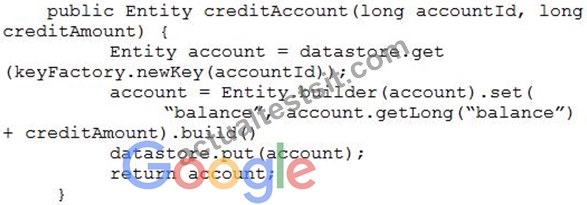
- A. Get the entity with an ancestor query.
- B. Don't return the account entity from the function.
- C. Get and put the entity in a transaction.
- D. Use a strongly consistent transactional database.
Answer: A
NEW QUESTION # 104
......
Latest Professional-Cloud-Developer Exam Dumps Google Exam from Training: https://protechtraining.actualtestsit.com/Google/Professional-Cloud-Developer-exam-prep-dumps.html