

[Sep 09, 2026] New Appian ACD101 Dumps with Test Engine and PDF (New Questions)
Pass Your ACD101 Exam Easily - Real ACD101 Practice Dump Updated
Appian ACD101 Exam Syllabus Topics:
| Topic | Details |
|---|---|
| Topic 1 |
|
| Topic 2 |
|
| Topic 3 |
|
| Topic 4 |
|
| Topic 5 |
|
| Topic 6 |
|
NEW QUESTION # 13
Which three of the following are valid page types in a site? (Choose three.)
- A. Action
- B. Interface
- C. Tempo
- D. Record List
- E. News Feed
Answer: A,B,D
NEW QUESTION # 14
An interface references an expression rule.
What are the relationships between these objects?
- A. Inheritance and Association
- B. Dependents and Reliants
- C. Dependents and Precedents
Answer: C
Explanation:
In Appian, when an interface references an expression rule, the interface is considered a dependent because it depends on the expression rule to function correctly. Conversely, the expression rule is a precedent because the interface relies on it.
Reference:
Appian Documentation: Managing Application Contents
NEW QUESTION # 15
You receive the following error message after creating a dropdown field:
What could be the problem?
- A. The choiceLabels have too few labels.
- B. The choiceValues has too few values.
- C. The choiceLabels and choiceValues datatypes do not match.
Answer: B
Explanation:
The error message indicates that the choiceValues array is not the same length as the choiceLabels array. In this scenario, there are more labels than values, which means the choiceValues array needs additional values to match the number of labels.
References
* Appian Documentation: Dropdown Field
NEW QUESTION # 16
You need to remove an unused field from an existing record type Product, which has data sync enabled and is backed by a database table.
What should you do?
- A. Delete the column from the database table and perform a full resync of the record type.
- B. Delete the field from the product Custom Data Type (CDT) and perform a full resync of the record type.
- C. Delete the field from the record type and optionally delete the column from the database table.
Answer: B
Explanation:
In Appian, when dealing with a record type that has data sync enabled and is backed by a database table, changes to the structure of the underlying data model, such as removing a field, should be carefully managed. The correct approach involves deleting the unused field from the Custom Data Type (CDT) that defines the structure of the data for the record type. Following this change, a full resynchronization of the record type is necessary to ensure that the changes in the CDT are reflected in the record type and its associated data in Appian. This process ensures data integrity and consistency across the application and the database.
Reference:
Appian Documentation on Data Management: Provides guidelines on managing data structures, including CDTs and record types, within Appian applications.
NEW QUESTION # 17
Which option best describes the primary purpose of the interface design object?
- A. Provides a method for an Appian application to interact with an external application or service.
- B. Provides a method for end users to interact with an Appian application.
- C. Provides a method for an Appian application to interact with a database.
Answer: B
Explanation:
The primary purpose of the interface design object in Appian is to provide a method for end users to interact with an Appian application. Interfaces are the user-facing components that allow for the input, display, and manipulation of data within the application, facilitating user engagement and task completion.
Reference:
Appian Documentation: Interface Design
NEW QUESTION # 18
You need to add a new attribute to your database-backed synced Acme employee record.
What should you do?
- A. In the record data model, you add the new field in the ADD SOURCE FIELDS. Save the field with the Update Table checkbox active.
- B. In the record data model, you add the new field with ADD RELATIONSHIPS. Save the newly created relationship and use the field.
- C. Add the new field manually to the ACME_Employee database table and run a database script to resync the Acme employee record.
Answer: A
Explanation:
To add a new attribute to a database-backed synced record type, such as an Acme employee record, you should add the new field under the 'Add Source Fields' section in the record data model configuration. When you save this new field with the 'Update Table' checkbox selected, Appian will automatically update the underlying database table and resync the record type with the new field included.
Reference: Appian Documentation - Modifying Record Data Models
NEW QUESTION # 19
A customer wants to display a small toolbar with three icons - a "sad face," a "face with neutral expression," and a "happy face" - on the bottom of every page in their application.
Users will be instructed to use the icon that best expresses their current experience using the application. This will allow the customer to collect valuable data about users.
Which object type should be called from each page to implement this feature?
- A. A decision, because the component captures a choice that users select from an array of custom selection components, rather than a standard dropdown or radio button.
- B. An expression rule, because the component captures expressions of user sentiment for analysis.
- C. An interface, because the component must render user interface elements.
Answer: C
Explanation:
In Appian, interfaces are used to design and render user interface elements, allowing for the creation of custom layouts and components that can interact with users. In this scenario, the toolbar with emotion icons is a UI element that needs to be consistently presented across various pages. Using an interface ensures that these icons can be interactively used by users to express their sentiments, and the data collected can be analyzed for user experience insights. Interfaces are capable of embedding such UI elements and can be invoked or included across multiple pages within an application, making them the ideal choice for this requirement.
Reference:
Appian Documentation on Interfaces: Provides detailed guidance on how to design and use interfaces to create user-centric UI components.
NEW QUESTION # 20
In an expression you see the following two code snippets A and B.
Do the two code snippets return the same result?
- A. Yes, both code snippets return the exact same Boolean value.
- B. No, A returns the Boolean values TRUE or FALSE, while B returns the strings "true" or "false".
- C. No, A returns the text "true" or "false", while B returns the Boolean values TRUE or FALSE.
Answer: A
NEW QUESTION # 21
You received a support ticket where the user claims that nothing happens when they click the button to complete a task. You confirm that the user is assigned to the task.
What is a possible reason for this problem?
- A. The button was not configured to submit the form.
- B. The process report that drives the runtime database does not have security set properly.
- C. The user was not in the user group configured for the process model security.
Answer: A
Explanation:
If a user claims that nothing happens when they click a button to complete a task, a possible reason could be that the button was not configured to submit the form. This configuration is essential for triggering the form submission action, which in turn can complete the task or initiate further processes. Without this setup, clicking the button will not result in any action.
References
* Appian Documentation: Configuring Buttons in Interfaces
NEW QUESTION # 22
A process model is currently being used to handle job applications.
For each new applicant, a User Input Task is assigned to the human resources (HR) Recruiter group for initial processing.
Later in the process, users in the HR Supervisor group are sent an email instructing them to schedule the candidate's final interview. The process is working as expected.
Today, users in the HR Recruiter group requested that they do not receive email notifications for the initial processing of job applications. It is, however, critical for those in the HR Supervisor group to continue receiving e-mails.
How should you address this requirement?
- A. Update the settings in the Admin Console to disable outbound email from Appian.
- B. Update the user input node in the process model to disable notifications for task assignments.
- C. Update the HR Recruiter group settings to disable email notifications.
Answer: C
NEW QUESTION # 23
Which Appian feature helps you access enterprise data quickly, define easily leveraged relationships, and establish custom fields based on available information?
- A. Task Management
- B. Record types with data sync enabled
- C. Process Analytics
Answer: B
NEW QUESTION # 24
You built a grid field with the data source as a query entity.
You want to add a search box to the grid using Appian's out-of-the-box functionality. You set the parameter of showSearchBox to "True", but the search box is still not appearing.
Why is the search box NOT appearing?
- A. The grid is on an interface that needs to be placed within a report object.
- B. The showSearchBox parameter only applies when a record type is used as the source in the data.
- C. The search box only appears when data is populated in the grid.
Answer: B
NEW QUESTION # 25
You are creating a new customer onboarding application. Documents are required from customers for verification and onboarding purposes. You need to store these documents within Appian.
Which two areas in Appian should you configure? (Choose two.)
- A. Decision Object
- B. Folder
- C. Feed
- D. Knowledge Center
Answer: B,D
Explanation:
In Appian, to store documents such as those required for customer onboarding, you should configure a Knowledge Center and within that, Folders. The Knowledge Center in Appian serves as the top-level container for storing and organizing documents and folders. Folders within a Knowledge Center provide a way to categorize and manage access to documents, making them an essential part of document management in Appian applications. Decision Objects and Feeds are not related to document storage.
References: Appian Documentation - Knowledge Centers and Folders
NEW QUESTION # 26
You have two Custom Data Types (CDT): ACME_invoice and ACME_invoiceItem that have a flat relationship.
The invoice item table has a field that is a foreign key to the invoice table. You are leveraging the database to automatically generate their primary keys.
How should you structure the process model to add a new invoice and the new invoice items to the system?
- A. 1. Write to Data Store Entity smart service (Writing to the ACME_invoiceItem table).
2. Script Task to update foreign keys.
3. Write to Data Store Entity smart service (Writing to the ACME_invoice table). - B. 1. Write to Multiple Data Store Entities smart service (Writing to the ACME_invoiceItem table and ACME_invoice table).
- C. 1. Write to Data Store Entity smart service (Writing to the ACME_invoice table).
2. Script Task to update foreign keys.
3. Write to Data Store Entity smart service (Writing to the ACME_invoiceItem table).
Answer: C
Explanation:
When dealing with related data types where one has a foreign key to another, you must first create the record in the primary table (ACME_invoice) and then use the generated primary key to create related records in the secondary table (ACME_invoiceItem). This is why you first write to the ACME_invoice table, then update the foreign keys in a Script Task, and finally write to the ACME_invoiceItem table.
Reference:
Appian Documentation: Relational Databases
NEW QUESTION # 27
A user needs to navigate from a record summary to an external URL.
Which interface component can be used to support this goal?
- A. Card Layout with a link
- B. Record Link
- C. Button
Answer: C
NEW QUESTION # 28
Match each Appian object with the security inheritance rule that applies to it.
Note: Each rule will be used once.
Answer:
Explanation:
Explanation:
Process Models # Never inherit security; therefore, security must be set individually.
Documents # Always inherit security from their parent document folder.
Custom Data Types (CDTs) # Do not have security role maps.
Process models do not inherit security from process model folders, so their role maps must be configured independently. This is important because process models support specialized permissions such as Viewer, Initiator, Manager, Editor, and Administrator. Documents behave differently: they always inherit security from their parent document folder, meaning document access is controlled at the folder level. Custom Data Types do not have independent security role maps because they are used within the context of another secured Appian object. For example, when an interface uses a CDT, access is governed by the interface and the other objects involved in the feature. These distinctions prevent developers from assuming that every object follows the same inheritance model and support Appian's layered-security approach.
NEW QUESTION # 29
Review the following expression rule: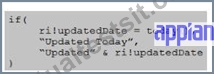
The updatedDate is of type "Date", and current datetime is 01/01/2023 5:00 PM GMT+00:00.
What is the output of this expression if the value of updatedDate was saved as today() one(1) hour ago?
- A. Updated Today
- B. Updated 01/01/2023 4:00 PM GMT+00:00
- C. Updated 01/01/2023
Answer: A
NEW QUESTION # 30
You are configuring a Related Action for an entity-backed record type.
What is the proper domain prefix to reference the record data that will be passed into the Process Model as context for the Record Action?
- A. ac!
- B. rv!
- C. pv!
Answer: C
Explanation:
When configuring a Related Action for an entity-backed record type, the proper domain prefix to reference the record data passed into the Process Model as context for the Record Action is pv!. This prefix stands for process variables, which are used to pass data into and out of a process model. In the context of a Related Action, pv! would be used to reference the specific process variables that are configured to receive the record data.
Reference: Appian Documentation - Process Variables and Record Types
NEW QUESTION # 31
What is the impact of reordering fields in a record type backed by a database table?
- A. Column ordering in the database table will change.
- B. Attributes in Custom Data Types (CDT) will change.
- C. There is no impact from the change.
Answer: C
NEW QUESTION # 32
......
ActualTestsIT just published the Appian ACD101 exam dumps!: https://protechtraining.actualtestsit.com/Appian/ACD101-exam-prep-dumps.html